
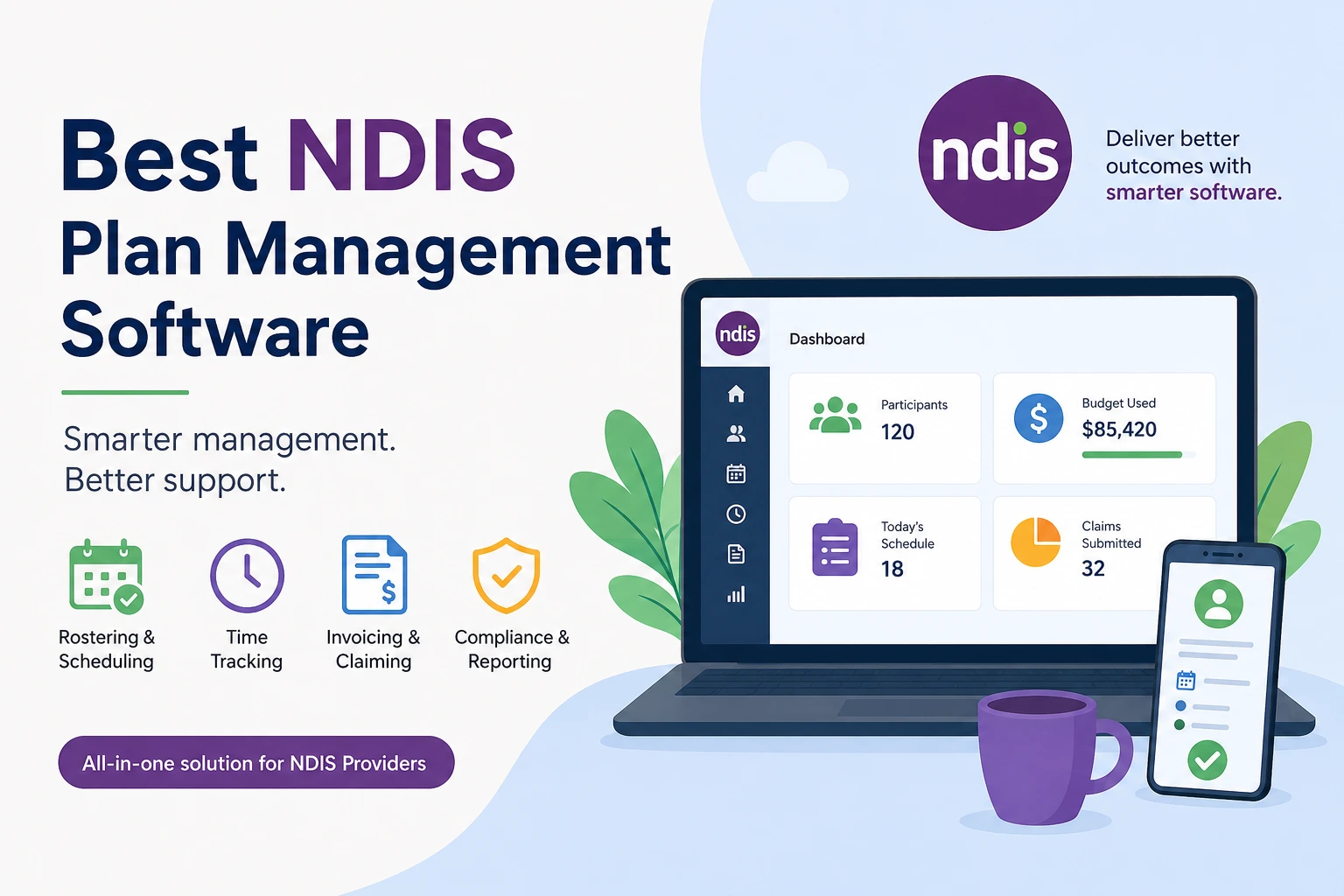
NDIS plan management software helps providers manage participant plans, budgets, invoicing, claims and compliance from a single system. The right platform reduces manual admin, keeps claims audit-ready, and gives providers real-time visibility over every participant's funding. This guide covers what the software does, what it costs, what to check before you buy, and how Ausvanta fits into an Australian provider's workflow.
Running an NDIS provider business means juggling rosters, invoices, participant budgets and claims — often across spreadsheets and separate logins. Plan management is now the default way participants fund their supports, which means providers need software that keeps pace with claiming rules, pricing updates and reporting obligations. This guide breaks down what NDIS plan management software actually does, what to check before choosing a platform, and how Ausvanta supports Australian providers with their day-to-day plan administration.
NDIS plan management software is a digital platform that helps providers and plan managers track participant plans, budgets, invoices and claims in one place, instead of managing them manually across spreadsheets and email. It typically covers participant records, rostering, timesheets, invoicing, claim submission and compliance reporting.
It's worth separating two related but different tools, because the term gets used loosely in the market:
Both categories touch "plan management" in the broad sense — they both deal with a participant's funded plan, budget and claiming — but they solve different problems for different types of business. Understanding which one you need before you compare products saves a lot of wasted demos.
| Feature | Dedicated Plan Manager Platforms | Provider Operations (e.g. Ausvanta) | Generic Practice Management |
|---|---|---|---|
| Primary Focus | Processing invoices & NDIA claims | Rostering, time tracking & service delivery | General scheduling & admin |
| Target Audience | Registered Plan Managers | Disability service providers (SIL, Support Workers) | Clinics/General health practices |
| NDIS-Specific Tools | High-volume budget validation | Rostering, incident logs, NDIS invoicing | Limited to zero |
| Best For | Financial intermediaries | Growing NDIS care businesses | Small non-NDIS clinics |
Plan management has become the most common way NDIS participants fund their supports, which means the volume of invoices, claims and compliance checks flowing through providers has grown sharply. Choosing the right software affects cash flow, audit-readiness and how much time staff spend on admin instead of service delivery.
According to NDIS quarterly data, the majority of participants now use a plan manager for some or all of their funding, with the rest split between self-management and full NDIA management. With well over 770,000 participants holding approved plans nationally, the invoicing and claiming workload across the sector is substantial — and it keeps growing as the Scheme expands.
For providers, that growth shows up as more invoices to raise, more claims to track, and more compliance documentation to keep audit-ready. Manual spreadsheet-based processes tend to break down at this scale: claims get missed, budgets aren't checked in real time, and staff spend hours on data entry that software can do automatically.
The best NDIS plan management software combines participant and budget tracking with rostering, invoicing, compliance and reporting, so a provider isn't stitching together multiple disconnected tools.
A central place to store each participant's plan details, funding categories, start and review dates, goals and service agreements — so staff aren't hunting through email threads or paper files to confirm what's approved.
Tools to build staff rosters, match support workers to participants, and manage shift changes, so scheduling doesn't rely on phone calls and group chats.
GPS-verified clock-in/clock-out for field staff, with timesheets that build themselves from actual shift data rather than being re-typed at the end of the week.
Automated, NDIS-compliant invoice generation that aligns with the current NDIS Pricing Arrangements and Price Limits (PAPL), reducing the risk of over-claiming or using an outdated line-item code.
A structured way to log incidents, case notes and progress records, supporting NDIS Practice Standards obligations and giving you an audit trail if the NDIS Commission ever asks for one.
Dashboards and exportable reports that show funding usage, worker compliance and service delivery at a glance, so preparing for an audit doesn't mean weeks of manual collation.
Role-based access control and Australian data residency matter for any system handling participant health and financial information. Look for hosting within Australia and clear alignment with relevant standards.
Providers and plan managers interact with two main NDIA systems: the my NDIS provider portal for viewing participant plan information, and the myplace provider portal for submitting claims and payment requests. Good software should make both processes easier, not replace the need to understand them.
The NDIA has been rolling out a new computer system (PACE) alongside the existing myplace portal. Under PACE, plan managers and providers use the my NDIS provider portal to view participant plan and budget information, while claims for payment continue to be submitted through the myplace provider portal. Software that keeps pace with these changes — rather than assuming a single static claiming process — will save your team from re-learning workflows every time the NDIA updates its systems.
Plan management is funded by the NDIA through a participant's Improved Life Choices budget, at a set monthly rate that is reviewed annually — participants are not charged directly for this service.
Under the 2025–26 NDIS Pricing Arrangements and Price Limits, the national price limit for plan management is approximately $104.45 per month, funded from the Improved Life Choices support category rather than a participant's Core Supports or Capacity Building budgets. From July 2025, remote and very remote loadings for this fee were removed, so the rate applies consistently regardless of location. Registered plan managers cannot charge participants above this NDIA-funded rate.
This is a separate matter from what a provider charges for the actual supports it delivers (support work, therapy, etc.), which is governed by its own line items in the same Pricing Arrangements document. Software that keeps both sets of rates current — and flags when an invoice exceeds the applicable limit — protects providers from compliance issues and rejected claims.
Before comparing vendors, clarify the size of your organisation, the number of participants you support, and whether you need plan-manager-style claiming tools or broader provider operations tools — then shortlist against a consistent checklist.
| Category | Best for | Typical features |
| Dedicated plan manager platforms | Registered plan management businesses processing high volumes of participant invoices and NDIA claims | Invoice validation against budgets, direct NDIA claiming, participant-facing balance apps |
| Provider operations platforms (e.g. Ausvanta) | Disability service providers delivering direct supports (support work, SIL, allied health) | Rostering, incident management, time tracking, NDIS-aligned invoicing and claiming, compliance reporting |
| Generic practice management software | Providers wanting broad clinical/practice tools not NDIS-specific | General scheduling and billing, limited built-in NDIS pricing alignment |
Ausvanta is NDIS software for Australian providers, built around rostering, incident management, time tracking, invoicing and claiming in one platform, developed by Cognify Digital Australia and hosted on AWS in Sydney.
Ausvanta is designed for providers who want to manage the day-to-day plan-related administration of running an NDIS service — rather than a standalone claiming tool for registered plan management businesses. Key aspects of the platform include:
Because compliance requirements and system integrations evolve as the NDIA updates PACE and its provider portals, it's worth confirming current claiming and integration capability directly with Ausvanta before onboarding, rather than assuming feature parity with dedicated plan-manager claiming platforms.
The most frequent mistakes are picking software built for the wrong business model, underestimating true cost as participant numbers grow, and assuming a platform is compliant without checking how it handles current NDIS pricing.
Most providers move from manual spreadsheets to software in three practical steps: sign up and choose a plan sized to current participant numbers, import existing participant and staff data, then go live with rostering, time tracking and invoicing running in parallel with the old process for one billing cycle before switching over fully.
It's a digital platform that helps providers or plan managers track participant plans, budgets, invoices and NDIA claims in one system, replacing manual spreadsheets and separate portal logins.
Participants don't pay directly. Under the 2025–26 NDIS Pricing Arrangements, plan management is funded by the NDIA at approximately $104.45 per month from the Improved Life Choices budget.
A plan manager is a registered business that processes a participant's invoices and claims across all their providers. Provider operations software, like Ausvanta, helps a service provider run its own rostering, timesheets, invoicing and compliance for the supports it delivers.
Yes. Self-managed participants can use registered or unregistered providers and aren't restricted to NDIS price limits, though most providers still price in line with the published Pricing Arrangements as a benchmark.
Yes. NDIA-managed participants can only use registered NDIS providers, and those providers must charge within the NDIS Pricing Arrangements and Price Limits.
PACE is the NDIA's newer computer system. Under PACE, the my NDIS provider portal is used to view participant plan and budget details, while the myplace provider portal is still used to submit claims for payment.
Providers delivering supports generally need to meet NDIS Commission registration requirements relevant to their services; the software itself supports compliance but registration obligations sit with the provider or plan manager as a business.
Rostering, time tracking, and NDIS-compliant invoicing tend to deliver the fastest time savings for small teams, with compliance reporting becoming more important as participant numbers grow.
The NDIA conducts an Annual Pricing Review, with updated Pricing Arrangements and Price Limits typically effective from 1 July each year, alongside occasional in-year updates.
Ausvanta provides invoicing and claiming tools aligned with NDIS pricing as part of its provider operations platform; providers should confirm current claiming and portal integration details directly with Ausvanta for their specific setup.
Ausvanta is hosted on AWS in Sydney, providing Australian data residency for participant and provider information.
A plan manager checks invoices from every provider a participant uses against their overall budget and submits claims to the NDIA on the participant's behalf — a cross-provider role that sits above any single provider's own operations software.
Yes. Centralised records, compliance dashboards and exportable reports make it faster to assemble documentation for an NDIS Commission audit than working from scattered spreadsheets and emails.
Start your free 14-day trial — unlimited users, no credit card required.