
x
NDIS software for providers is no longer optional admin — it's how a business proves it's audit-ready, pays staff correctly under the SCHADS Award, and gets paid on time by the NDIA. If your team is still juggling five spreadsheets, chasing paper timesheets, and hoping incident reports don't go missing right before an audit, you already know the real cost: unbilled hours, compliance risk, and burnt-out coordinators.
From 1 July 2026, the stakes rose again. Mandatory registration landed for Supported Independent Living (SIL) and digital platform providers, and the Fair Work Commission's Annual Wage Review lifted every SCHADS Award rate by 4.75%. Margins tightened on both sides at once.
Ausvanta was built to answer exactly this problem: one platform for rostering, GPS-verified time tracking, incident management, NDIS claiming and compliance, with unlimited users on every plan. Below is a walkthrough of how Ausvanta actually works, how it stacks up against other NDIS software, and how to try it free for 14 days.
NDIS software for providers is a digital platform that manages the operational and compliance side of running an NDIS business — participant records, staff rostering, shift time tracking, incident reporting, claiming against approved plans, and audit evidence — in one connected system instead of spreadsheets, paper files and disconnected apps.
Most providers start out on spreadsheets and a shared drive. That works for a handful of participants. It stops working the moment a roster clash happens at 6am, a support worker's Working with Children Check quietly lapses, or an auditor asks for six months of incident records at once. NDIS software exists to close that gap: it links the participant's plan and goals to the roster, the roster to the timesheet, the timesheet to the claim, and every incident to an audit-ready trail — so nothing has to be re-typed, re-checked or re-found under pressure.
Providers need dedicated software in 2026 because the NDIS market is more fragmented and more regulated than ever: 277,376 active providers are competing for 774,456 participants — fewer than three participants per provider on average — while new registration, practice-standard and wage obligations all commenced on 1 July 2026.
Three shifts make manual processes riskier this year specifically:
None of this is a reason to panic. It is a reason to stop running a regulated business on tools that were not built around the NDIS Practice Standards that commenced on 1 July 2026 — so a provider can hand an auditor a record, not a promise.
Data is hosted on AWS in Sydney, with role-based access to protect participant information. SCHADS-aligned rostering rules apply today, and PRODA integration is in progress as the NDIA's claims and payments system continues rolling out real-time digital evidence requirements through to 2030.
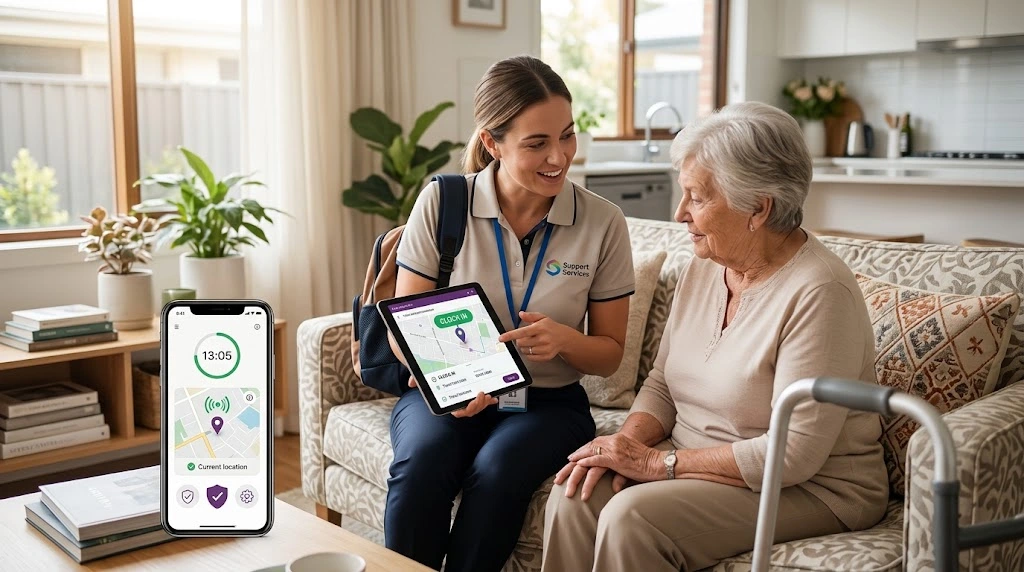
The Ausvanta mobile app gives support workers their shifts, care notes and incident forms, plus GPS and selfie clock-in, so the field and the office are working from the same live data.
This is what keeps the rest of the platform accurate — a roster is only as good as the clock-in data that confirms it happened. More detail is on the Worker Mobile App page.
Live dashboards track shifts, incidents, funding utilisation and workforce KPIs in real time — the numbers that tell a provider whether the business is sustainable, not just busy.
Ausvanta differs from most NDIS software by including unlimited users on every plan and Sydney-hosted data as standard, rather than charging per seat — a meaningful difference for providers whose staff count grows faster than their participant count.
The Australian NDIS software market includes well-established platforms such as ShiftCare, SupportAbility, Lumary and Brevity Care, each aimed at a different scale of provider. The comparison below is a general guide based on publicly available positioning and pricing information; always confirm current plans directly with each vendor.
| Platform | Best for |
|---|---|
| Ausvanta | Small–mid providers wanting one connected platform |
| ShiftCare | Rostering-led in-home and community providers |
| SupportAbility | Compliance documentation, mid–large providers |
| Lumary | Large, complex organisations (Salesforce-based) |
| Brevity Care | Small–mid community services providers |
A few patterns worth noting from the competitor landscape: rostering-led platforms like ShiftCare suit direct-support providers with large casual workforces, compliance-first platforms like SupportAbility suit providers where documentation depth is the priority, and enterprise platforms like Lumary suit large, multi-service organisations willing to invest months in implementation. Ausvanta sits in the small-to-mid segment, aimed at providers who want rostering, time tracking, incidents, claiming and compliance in one system without per-seat pricing or a lengthy rollout.
Ausvanta is built for Australian NDIS providers who:
NDIS software pricing varies considerably across the market. Many platforms use per-user pricing, while enterprise systems may use customised pricing. Ausvanta takes a different approach, with unlimited users on every plan.
Per-user pricing can work well for a small, stable team. It becomes expensive quickly for providers who scale their support worker pool up and down with participant demand — which describes most NDIS providers, given the sector averages fewer than three participants per provider. Ausvanta's current plans are finalised during the free trial period, with every feature available and no credit card required to start.
Getting live takes four steps:
Full plan details are on the Pricing page, and the team can be reached directly via the Contact page or on +61 468 167 862.
Before signing up to any NDIS software — Ausvanta included — weigh it against these points:
The best way to know whether NDIS software fits how your team actually works is to run a real roster through it. Ausvanta's free 14-day trial includes every feature, unlimited users, and no credit card required.
Want to talk it through first? Call the Ausvanta team.
1. What is NDIS software for providers?
NDIS software for providers is a platform that manages participant records, staff rostering, time tracking, incident reporting, claiming and compliance evidence in one system, replacing spreadsheets and paper-based processes.
2. How does Ausvanta work?
Ausvanta connects rostering, GPS time tracking, incident management, claiming and compliance so that shift data flows automatically from the roster to the timesheet to the claim, with a mobile app for support workers in the field.
3. Is Ausvanta free to try?
Yes. Ausvanta offers a free 14-day trial with full features and no credit card required, so a provider can test rostering, time tracking, incidents and claiming before committing.
4. How much does NDIS software cost?
Across the market, NDIS software typically costs $8 to $20 per user per month, with enterprise platforms priced individually. Ausvanta includes unlimited users on every plan rather than charging per seat.
5. Is Ausvanta SCHADS Award compliant?
Ausvanta's rostering applies SCHADS-aware rules to help providers schedule shifts in line with the award, including the 4.75% rate increase that took effect from 1 July 2026. Providers remain responsible for confirming pay outcomes against the current Fair Work Ombudsman pay guide.
6. Where is Ausvanta's data hosted?
Ausvanta is hosted on AWS in Sydney, with role-based access designed to protect participant and staff information within Australia.
7. Do I need to be a registered NDIS provider to use Ausvanta?
No. Ausvanta is built for both registered and unregistered NDIS providers, including those newly required to register as SIL or platform providers from 1 July 2026.
8. What changed for NDIS providers on 1 July 2026?
From 1 July 2026, Supported Independent Living and NDIS platform providers must be registered with the NDIS Quality and Safeguards Commission under registration group 0138, and a new SIL Practice Standards module commenced alongside a 4.75% SCHADS Award wage increase.
9. Does Ausvanta handle NDIS claiming?
Yes. Ausvanta generates claim exports and invoices directly from delivered shifts, priced against the current NDIS price guide, so claims reconcile with rostered and approved hours.
10. How many participants and providers are in the NDIS in 2026?
As at 31 March 2026, the NDIS had 774,456 participants with approved plans and 277,376 active providers, according to the NDIA's Q3 2025–26 Quarterly Report.
Disclaimer: NDIS participant, provider and pricing figures in this article reflect the NDIA's Quarterly Report and Fair Work Commission decisions current as of the March 2026 quarter and the 2026 Annual Wage Review. NDIS rules, registration requirements, SCHADS Award rates and state-based policies are updated periodically — always confirm current figures and obligations directly with the NDIA, the NDIS Quality and Safeguards Commission, and the Fair Work Ombudsman before making compliance or business decisions built for the regulation.
Start your free 14-day trial — unlimited users, no credit card required.