
Data as at 31 March 2026. This equates to fewer than three participants per active provider as a simple market-level ratio — not an average provider caseload.
If you're asking how to get NDIS clients as a provider, the honest answer is that the National Disability Insurance Scheme isn't short of participants — it's short of providers who are easy to find, easy to trust, and easy to refer. With more than 774,000 Australians now holding an approved NDIS plan and average provider caseloads under three participants, growth is a visibility and referral problem, not a demand problem. This guide walks through what actually moves the needle in 2026: how participants and Support Coordinators choose providers, the official NDIA process that connects you to them, and why compliance systems are quietly becoming part of your marketing.
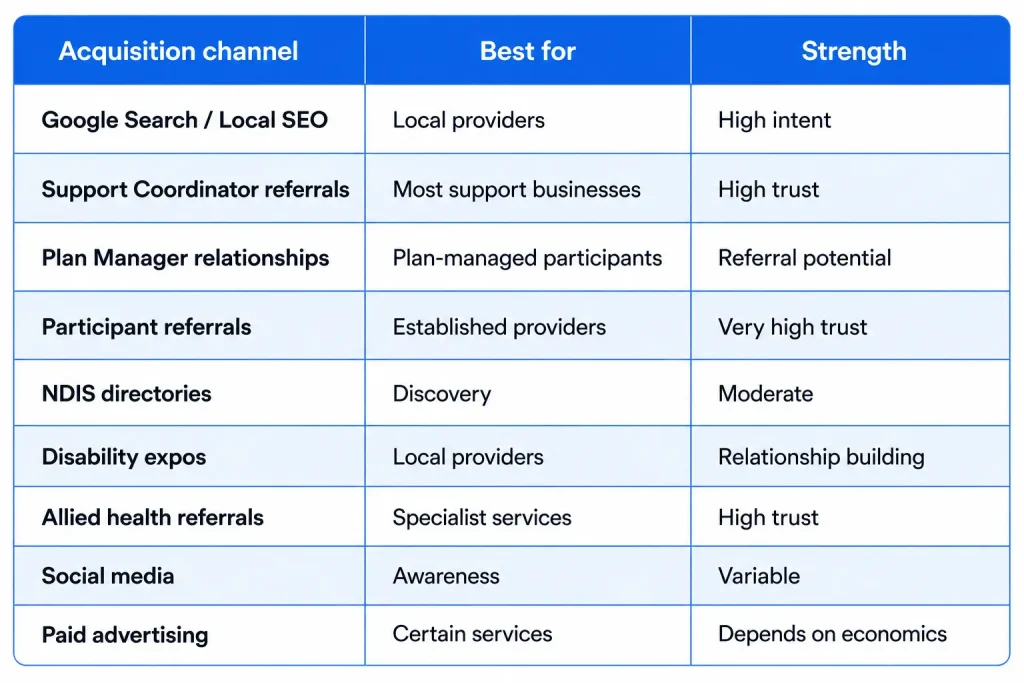
| Provider Type | Primary Acquisition Channels |
|---|---|
| Disability support providers | Local SEO Support Coordinator relationships Participant referrals |
| SIL providers | Support Coordinators Participants & families Demonstrable compliance Local reputation |
| Allied health providers | Professional referrals Google search GP & allied-health networks |
| Plan managers | Participant referrals Support Coordinator relationships Professional networks |
| Support coordinators | Participant referrals LAC & NDIA relationships Local visibility |
NDIS client acquisition is the ongoing process of attracting, qualifying and onboarding new NDIS participants as clients. In 2026 it has shifted from informal word-of-mouth toward structured digital visibility, formal referral pathways with Support Coordinators and Plan Managers, and demonstrable compliance — driven by scheme growth, new registration rules, and participants increasingly comparing providers online before making contact.
The scheme has grown quickly and is still growing. According to the NDIA's Quarterly Report for the March 2026 quarter, 774,456 participants held an approved NDIS plan as at 31 March 2026 — a net increase of 13,014 participants (1.7%) over the previous quarter, with more than 18,500 new participants entering the scheme in that period alone.
Against that, the same report lists 277,376 active providers for the quarter — meaning the scheme currently averages fewer than three participants for every active provider. That single ratio explains why so many providers describe growth as "hard" despite rising participant numbers: the contest for clients happens locally, support by support, not nationally.
Meanwhile, 526,376 participants use a plan manager rather than managing funds themselves or relying solely on the NDIA, which matters because plan managers and Support Coordinators are frequently the ones recommending providers on a participant's behalf.
Participants and their support networks choose providers based on three overlapping factors: visibility (appearing where they search), credibility (evidence you deliver safe, quality support), and connection (a referral from someone they already trust, such as a Support Coordinator, Plan Manager or fellow participant).
Every effective NDIS growth strategy maps to one of these three pillars. Framing your marketing this way stops the common trap of doing a bit of everything without a clear priority.
Participants and family members increasingly research providers online before making contact, comparing services, locations and reviews the same way they would for any other service. If your business doesn't appear for searches like "NDIS provider near me" or a service plus suburb, you're invisible to that entire segment of demand — regardless of how good your support actually is.
Registration status, worker screening compliance, transparent policies, genuine testimonials and a professional online presence all signal to a nervous participant or a risk-averse Support Coordinator that you're a safe choice. This is where operational compliance stops being back-office admin and starts functioning as a trust signal.
Most experienced providers will tell you referrals from Support Coordinators, Plan Managers, allied health professionals and other participants convert better than any advertisement, because someone the participant already trusts is vouching for you.
Quick answer: A conversion-ready NDIS provider website clearly states the services offered, the locations covered, who the team supports, and how to make an enquiry — paired with an optimised Google Business Profile and consistent local SEO signals so the business surfaces in location-based searches.
Your website is frequently a participant's or Support Coordinator's first real interaction with your organisation. It should answer, within seconds, the questions every visitor is silently asking:
Local search can be an important discovery channel for providers serving specific suburbs, cities or regions. Common search patterns include location-qualified phrases such as "disability support [suburb]", "NDIS provider near me" and "self-managed NDIS provider [city]". To capture that traffic:
Beyond your own website, participants and Support Coordinators regularly browse third-party provider directories to compare and shortlist options. Listing on reputable, actively maintained NDIS-specific directories — with a complete, accurate profile — is a low-cost way to be discovered by people who are already in-market and comparing providers side by side.
Build referral relationships by directly introducing your organisation to local Support Coordinators, Plan Managers, allied health professionals and Local Area Coordinators, and by understanding the NDIA's formal "request for service" process — the official mechanism that actually assigns a participant to a provider once they've expressed a preference.
Many articles talk about "getting referrals" without explaining how a Support Coordinator relationship is formally recorded. According to the NDIA, once a participant tells the agency which support coordinator or provider they want to work with, the NDIA sends that provider a formal request for service through the my NDIS provider portal, the myplace provider portal, or by email.
The provider then has four business days to accept or decline the request in the portal before it's offered to someone else — which means providers who don't check their portal regularly can lose participants who specifically asked for them. Once accepted, the relationship becomes active, the provider gains visibility of the participant's plan, and is recorded as that participant's "my provider."
The practical implication: being a Support Coordinator's or Plan Manager's first recommendation is only half the job. Your organisation also needs the internal habit of monitoring the provider portal daily, because the four-day window is a hard cut-off, not a guideline.
A simple introduction — a short email, a face-to-face meeting, or a joint case discussion — genuinely moves the needle, because Support Coordinators repeatedly say they prioritise providers they know deliver consistent, reliable, well-documented support.
Offline visibility — disability expos, council and community networking events, and local partnerships — remains effective for NDIS providers because it builds the same face-to-face trust that drives referrals from Support Coordinators and participants.
Disability expos held across Australian cities bring participants, families, carers and fellow providers together in one place, making them one of the most efficient ways to have direct conversations with prospective clients and build referral relationships with other professionals in a single day.
Council-run community forums, allied health network events and local business chambers offer similar, smaller-scale opportunities. None of these replace a strong digital presence — but combined with it, they reinforce the credibility and connection that drive referrals.
Since 1 July 2026, mandatory registration applies to providers delivering SIL and NDIS digital platform services, raising the bar for demonstrable compliance across the sector — which means audit-ready systems for incidents, rostering and evidence are becoming a genuine trust signal for participants and referrers, not just a compliance cost.
The NDIS Commission's regulatory reform confirms that, from 1 July 2026, providers delivering Supported Independent Living or NDIS digital platform services must be registered with the Commission, alongside new SIL-specific Practice Standards covering supported decision-making, safeguarding, practice governance, and tenancy and housing arrangements.
For providers outside those two categories, the direct obligation may not apply yet — but the broader signal to the market is unmistakable: participants, families and Support Coordinators are being encouraged, through government communication and sector reporting, to see registration and demonstrated compliance as a marker of a safer, more trustworthy provider. An organisation that can show a Support Coordinator a clean audit trail, documented incident handling and credential records on request is simply easier to recommend than one that can't.
This is where the systems behind your service delivery start doing marketing work, even though nobody designed them that way. Consider:
None of this replaces genuinely good support work. But when your operational evidence is one click away instead of buried in spreadsheets and paper files, every credibility conversation with a participant or referrer gets shorter — and shorter conversations convert faster.
The most common mistakes are relying solely on word-of-mouth, having an incomplete or outdated online presence, ignoring the provider portal's request-for-service deadlines, and treating compliance as separate from — rather than part of — the case a provider makes to win new clients.
Retention depends on consistent, reliable service delivery — reliable rostering, clear communication, transparent handling of incidents and concerns, and demonstrating ongoing progress against a participant's plan goals — because a lost client is far more expensive to replace than a kept one.
Winning a new client is only the beginning; the scheme's fragmented economics mean losing one is proportionally costly. Reliability shows up in small, consistent moments: shifts that are actually covered, notes that are actually written up, and concerns that are actually followed up on. Providers who invest in the operational systems described above tend to retain participants longer, simply because fewer things go wrong in the background.
How do NDIS providers actually find new clients?
Providers find new clients through a mix of online visibility (website, Google Business Profile, local SEO), referral relationships with Support Coordinators and Plan Managers, provider directories, and community engagement such as disability expos.
What is the NDIA "request for service" and why does it matter for client acquisition?
It's the formal process the NDIA uses once a participant nominates a preferred Support Coordinator or provider. The NDIA sends that provider a request through the provider portal, which must be accepted or declined within four business days before it's offered elsewhere.
How many active NDIS participants and providers are there in 2026?
As at 31 March 2026, the NDIA reported 774,456 participants with approved NDIS plans and 277,376 active providers for the quarter — an average of fewer than three participants per active provider.
Do I need to be a registered NDIS provider to get clients?
Both registered and unregistered providers can support self-managed and plan-managed participants, but from 1 July 2026, registration is mandatory specifically for Supported Independent Living and NDIS digital platform providers, and registration status is increasingly used by participants and referrers as a trust signal.
How important is Google Business Profile for NDIS providers?
Very important — it's often how participants find local providers, and a complete, regularly updated profile with accurate service areas and reviews directly supports local search visibility.
Should I work with Support Coordinators or market directly to participants?
Both matter. Support Coordinator and Plan Manager relationships tend to produce steady, trust-based referrals, while direct online visibility captures self-managed participants and families researching independently.
What role do disability expos play in getting NDIS clients?
They provide direct, face-to-face access to participants, families and other professionals, and are a recognised way to build the referral relationships that convert into ongoing clients.
How does compliance affect my ability to attract NDIS clients?
Demonstrable compliance — audit-ready incident records, credential tracking, and reliable rostering — builds the credibility that Support Coordinators and cautious participants look for before recommending or choosing a provider.
What's the biggest mistake providers make when trying to grow their client base?
Relying solely on word-of-mouth without proactively building referral relationships or maintaining an accurate, complete online presence.
How can NDIS software help with client acquisition?
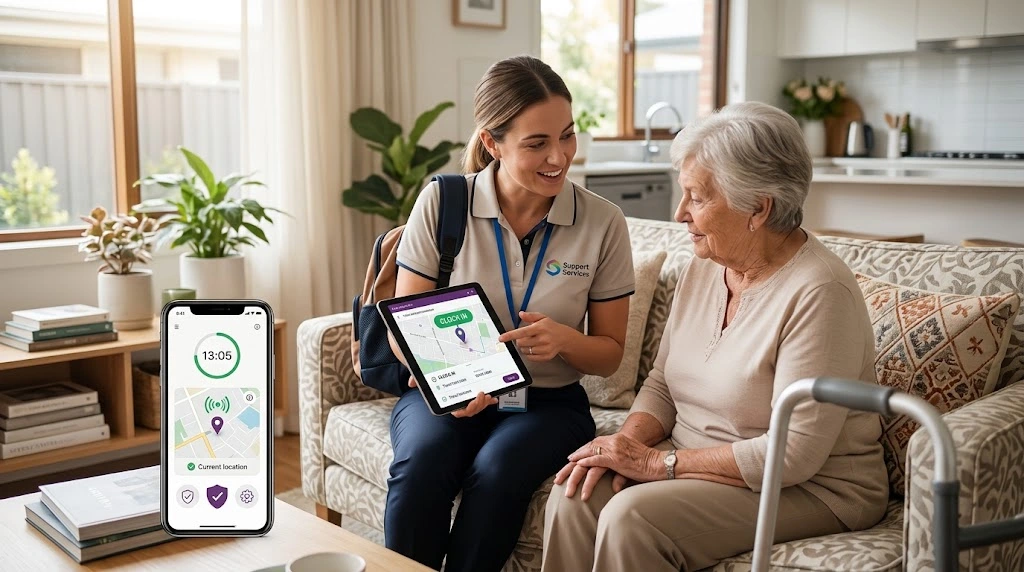
It doesn't generate leads directly, but reliable rostering, GPS time tracking, incident management and mobile tools reduce the service failures that damage trust — making it easier to convert and retain the clients your marketing brings in.
There's no single tactic that reliably delivers NDIS clients — sustainable growth comes from stacking visibility, credibility and connection, and backing all three with operations that don't let you down once a participant says yes. Providers who treat compliance and service reliability as part of their growth strategy, rather than separate from it, tend to build the steadiest referral pipelines over time.
If your rostering, time tracking, incident management or claiming processes are the thing slowing your growth down, Ausvanta is built specifically for Australian NDIS providers managing exactly these challenges — worth a look when you're ready.
Disclaimer
NDIS rules, registration requirements, provider and participant statistics, and government guidance change over time and can vary by state and territory. This article reflects publicly available information as at the time of writing; providers should confirm current requirements directly with the NDIS Commission and the NDIA before making compliance decisions.
Start your free 14-day trial — unlimited users, no credit card required.