
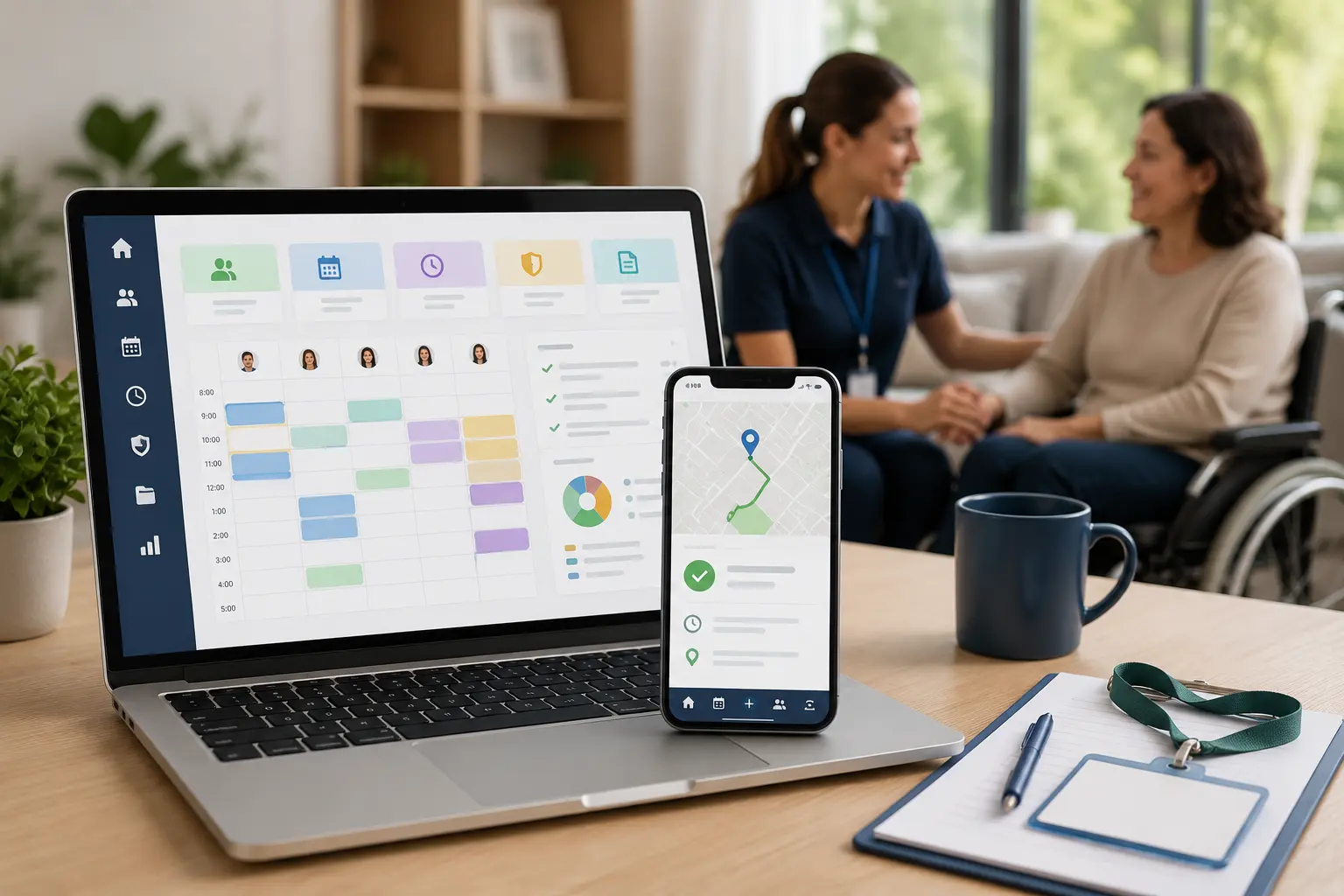
| Key Takeaways: NDIS software centralises rostering, time tracking, claiming, incident management and compliance for Australian disability providers.277,376 active providers now support 774,456 NDIS participants — fewer than three participants per provider on average, which is why efficient systems matter so much.From 1 July 2026, new NDIS Practice Standards apply and Supported Independent Living providers must register.The right software cuts claim rejections, keeps SCHADS Award rostering compliant, and keeps you audit-ready.Ausvanta bundles rostering, GPS time tracking, incidents, claiming and compliance in one AWS Sydney-hosted platform. |
Running an NDIS business in Australia means juggling rosters, claims, incident reports and audits — often across five different logins. Most providers still patch these jobs together with spreadsheets, paper case notes and disconnected apps, and that gap costs time, money and, eventually, compliance.
The right ndis software for providers australia turns these scattered tasks into one connected system. It matches support workers to shifts, tracks GPS-verified time in the field, and turns delivered services into clean claims against the current NDIS price guide. It also keeps an audit-ready trail for the NDIS Quality and Safeguards Commission.
This guide walks through what NDIS software actually does, what it costs in 2026, how to compare your options, and the mistakes that trip up growing providers. By the end, you'll know exactly what to look for — and why the platform you choose now matters more than ever, with new Practice Standards landing on 1 July 2026.
| NDIS software for providers in Australia is a digital platform that manages rostering, staff time tracking, incident reporting, claiming and compliance for organisations delivering National Disability Insurance Scheme supports. It replaces spreadsheets and paper records with one connected system built around the NDIS Practice Standards, the NDIS price guide and the SCHADS Award. |
In practice, it covers the full lifecycle of a support relationship: a participant's profile, goals and support plan; the roster that assigns a qualified worker to each shift; the shift notes and progress records that worker leaves behind; the claim that gets submitted once the shift is delivered; and the compliance evidence — credentials, incident reports, audit trails — that a provider needs on hand when the NDIS Commission comes knocking.
Most platforms group these functions into modules: participant management, staff management, rostering, care notes, incident reporting, claiming and invoicing, document management, and reporting. A smaller provider might only need a handful of these; a larger one will lean on all of them daily.
| Because the regulatory bar keeps rising. From 1 July 2026, Supported Independent Living providers must register and meet new SIL Practice Standards, and National Cabinet has set a target to cut annual NDIS cost growth to 8%. Software that automates rostering, claiming and compliance evidence saves hours every week and reduces audit risk. |
The scheme itself is enormous and still growing. As at the NDIA's March 2026 quarterly report, there were
774,456 active NDIS participants, supported by 277,376 active providers, according to the NDIA's quarterly reporting — an average of fewer than three participants per provider. That fragmentation is exactly why efficiency matters: a two-person support coordination business feels a missed claim or a compliance gap just as sharply as a large provider does, but with far less admin capacity to absorb it.
Total scheme expenses reached $46.3 billion on an accrual basis for the 2024–25 financial year, and National Cabinet wants annual cost growth brought down to 8% by 1 July 2026, from 10.8% a year earlier. That pressure flows straight through to providers, in the form of tighter pricing, closer scrutiny of claims, and a renewed push on quality and safeguards.
In December 2025, the Minister for the NDIS announced that Supported Independent Living providers must register from 1 July 2026 and meet new SIL Practice Standards — part of a broader NDIS Practice Standards reform responding to risks identified in supported accommodation. Providers who can already produce clean, digital compliance evidence will find that transition far less disruptive than those still relying on paper files.
Expert commentary: the pattern across every reform cycle since the scheme launched is the same — the providers who struggle are the ones treating compliance as a once-a-year scramble, not an everyday by-product of how they run rosters and record notes.
| Any organisation or sole trader delivering NDIS supports can use NDIS software — from solo support workers to providers with hundreds of staff. Registered providers must meet the NDIS Practice Standards and worker screening rules; unregistered providers still follow the NDIS Code of Conduct but face lighter registration requirements. |
The NDIS Quality and Safeguards Commission regulates both registered and unregistered providers, though only registered providers can deliver certain higher-risk supports, such as Specialist Disability Accommodation and behaviour support. Registration is a condition-based system: providers commit to the Code of Conduct, the relevant Practice Standards, incident reporting obligations, and worker screening for anyone in a risk-assessed role.
Worker screening itself is non-negotiable for risk-assessed roles — a worker must hold a valid clearance before starting, as set out on the NDIS Commission's worker screening guidance. Good NDIS software tracks these clearances the same way it tracks a driver's licence or a first-aid certificate — with expiry alerts, not a spreadsheet someone remembers to check.
| Look for rostering with SCHADS Award logic, GPS-verified time tracking, incident management, one-click claiming against the NDIS price guide, audit-ready compliance records, live reporting, and a mobile app your support workers will actually use in the field. | ||
| Feature | What it does | Why it matters |
| Smart rostering | Builds shift schedules that respect worker availability, qualifications and award rules. | Fewer scheduling conflicts and fewer manual overrides. |
| GPS time tracking | Verifies clock-in/clock-out from the support worker's location. | Timesheets that match what was actually delivered. |
| Incident management | Captures, escalates and tracks incidents through to resolution. | Meets NDIS Commission reportable-incident timelines. |
| Claiming & invoicing | Turns delivered shifts into claims and invoices automatically. | Fewer rejected claims, faster payment cycles. |
| Compliance & audit trail | Tracks credentials, evidence and history in one digital record. | Audit-ready without a scramble beforehand. |
| Reporting & analytics | Live dashboards on shifts, incidents, budgets and workforce data. | Decisions based on real numbers, not guesswork. |
| Mobile app | Lets support workers clock in, view shifts and log notes on the go. | Adoption in the field, not just in the office. |
Ausvanta covers each of these areas natively — see how it handles rostering and scheduling, GPS time tracking and incident management in more detail.
| NDIS software handles highly sensitive information — support plans, incident reports, health-adjacent notes — so data security is not optional. Look for role-based access controls, encrypted storage, a stated data hosting location, and a vendor that can explain its approach to the Australian Privacy Principles in plain language. |
Participant records typically include far more than contact details: goals, behaviour support plans, incident histories and sometimes health information. A breach or an unclear access model isn't just a technical problem — it's a trust problem with the people a provider supports and their families.
Practical questions worth asking any vendor: Where physically is the data hosted, and under which country's laws? Who inside the organisation can see what, and can that be restricted by role? How are backups handled, and how quickly can data be exported if a provider ever needs to switch systems? Ausvanta, for example, hosts data on AWS Sydney with role-based access, so participant information stays within Australian infrastructure by default.
| Small NDIS providers usually need core rostering, claiming and compliance without paying for enterprise-scale extras. Growing providers need the same fundamentals plus scalable reporting, multi-team rostering and pricing that doesn't punish headcount growth. |
A sole trader or a two-person support coordination business mostly needs the basics done reliably: accurate claims, simple rostering, and somewhere to keep compliance records that isn't a shoebox of paper. Overly complex platforms built for hundred-staff organisations can actually slow a small provider down.
Once a provider grows past a handful of staff, the priorities shift toward consistency: rosters that apply SCHADS Award rules the same way every time, dashboards that show funding utilisation across many participants at once, and compliance evidence that scales without adding a full-time admin role just to keep up. This is where per-user pricing models start to bite, and where an unlimited-user structure can be the more sustainable long-term choice.
| Most NDIS software in Australia is priced per active user, per month, typically from about $8 to $30 or more depending on features. Entry-level rostering-only tools sit at the low end; all-in-one platforms with claiming, compliance and unlimited users can offer better value once a team grows. |
Per-user pricing is the norm across the category — for example, ShiftCare's published NDIS software pricing starts from around $8–9 per user, per month, scaling up with more advanced modules. That model works well for a stable team, but it can penalise growth: every new support worker adds to the bill, even in a sector where staff turnover is high and rosters flex week to week.
Ausvanta takes a different approach, with unlimited users on every plan and Australian data residency in AWS Sydney included as standard rather than an add-on. As with any software purchase, always confirm the current published pricing directly with the vendor before signing — plans and inclusions change.
| Pricing model | Typical range | Best suited to |
|---|---|---|
| Per active user / month | $8–$30+ | Stable teams with predictable headcount. |
| Unlimited users, flat/tiered | Varies by provider | Growing teams, casual workforces, seasonal demand. |
| Free / rostering-only tools | $0–$10 | Very small providers with basic needs. |
| When comparing NDIS software, weigh compliance depth (SCHADS Award logic, audit trails), pricing structure (per-user vs unlimited), data hosting location, mobile usability for support workers, and how directly each vendor addresses the NDIS Practice Standards changes commencing 1 July 2026. |
The Australian NDIS software market includes several established platforms, each with a slightly different emphasis — some lead with rostering and SCHADS Award interpretation, others with care management or support coordination workflows. Feature sets and pricing change often, so treat any comparison (including this one) as a starting point, and confirm current details on each vendor's site or in a live demo before deciding.
| Dimension | What to check |
|---|---|
| Compliance depth | Does it map directly to the NDIS Practice Standards and SCHADS Award, or just general rostering? |
| Pricing structure | Per-user fees that grow with headcount, or a flatter model for a casual workforce? |
| Data hosting | Is participant data hosted in Australia, and is that stated clearly? |
| Mobile experience | Will support workers actually use the app in the field, or default to paper? |
| 2026 readiness | Does the vendor explicitly address the 1 July 2026 SIL registration and Practice Standards changes? |
| The most common mistakes are choosing on price alone, ignoring SCHADS Award logic in rostering, skipping a proper data migration plan, and not confirming where participant data is actually hosted. |
Most of these mistakes share a root cause: the decision gets made by comparing feature lists on a page, rather than by testing the software against a real week of rosters, real claims and a real audit request. A platform can look complete in a demo and still fall short once actual staff and actual participants are in the system.
| Map your must-have features, confirm SCHADS Award and Practice Standards support, check data hosting, trial it with real staff, and compare total cost at your actual (not current) headcount before committing. |
Picture a small Australian provider with a dozen support workers, running rosters in one spreadsheet, timesheets in another, and incident reports in a shared folder nobody quite trusts. Every payroll cycle means cross-checking three sources by hand, and every audit means hunting for evidence that should have been logged in real time.
Moving that operation onto one platform doesn't remove the underlying complexity of NDIS compliance — it just stops that complexity living in someone's head and scattered files. Rosters publish straight to workers' phones, GPS clock-ins build the timesheet automatically, and an incident gets logged the moment it happens, not reconstructed from memory a week later. This is illustrative of the kind of change providers commonly report — your own results will depend on your team, your current systems and how thoroughly you migrate your data.
| The SCHADS Award (Social, Community, Home Care and Disability Services Industry Award) sets minimum pay, penalty rates, allowances and rostering rules for most Australian disability support workers. NDIS software should apply these rules automatically when building rosters, flagging non-compliant shifts before they happen rather than after payroll. |
The award is administered by the Fair Work Ombudsman, and it covers matters like broken shifts, minimum engagement periods, weekend and public holiday loadings, and travel time between clients. Manually tracking all of this across a casual, mobile workforce is where rostering errors — and underpayment risk — creep in.
Quality rostering software doesn't replace the need to understand the award; it applies your interpretation of it consistently, shift after shift, so a tired admin at 5pm on a Friday doesn't have to remember every rule from memory.
| The NDIS Practice Standards set the quality and safety benchmarks registered providers must meet, organised into a core module for higher-risk supports, supplementary modules by service type, and a lighter verification module for lower-risk supports. Audit-ready providers keep this evidence current continuously, not just before a review. |
Full detail on the current standards sits with the NDIS Quality and Safeguards Commission, including the quality indicators auditors use to assess compliance. For providers preparing for the 1 July 2026 changes, the practical work is largely about evidence: incident registers, credential records, complaints logs, and behaviour support documentation that can be produced on demand.
Ausvanta's compliance and audit features are built around exactly this — digital audit trails, credential expiry alerts, and an incident register that maps to NDIS Commission reporting timelines, hosted on AWS Sydney.
| Switching from spreadsheets to purpose-built NDIS software typically means fewer rejected claims, faster payroll, real-time incident visibility, and compliance evidence that's ready before an audit is even scheduled. |
It's a reminder that no platform, including Ausvanta's, replaces good governance — but the right one makes good governance far easier to sustain day to day.
What is NDIS software for providers in Australia?
It's a digital platform that manages rostering, time tracking, incident reporting, claiming and compliance for organisations delivering NDIS supports, replacing spreadsheets and paper records with one connected system.
How much does NDIS software cost in Australia?
Most platforms charge per active user per month, typically from around $8 to $30 or more depending on features. Some providers, including Ausvanta, offer unlimited users instead of per-user fees — always confirm current pricing directly with the vendor.
Do sole traders need NDIS software?
Sole traders can operate with simpler tools, but many still use NDIS software for claiming accuracy, SCHADS Award rostering (if they employ staff) and to keep compliance records organised as the business grows.
What's the difference between registered and unregistered NDIS providers?
Registered providers are audited against the NDIS Practice Standards by the NDIS Commission and can deliver higher-risk supports. Unregistered providers still follow the NDIS Code of Conduct but face lighter registration requirements.
Can NDIS software handle SCHADS Award compliance?
Good NDIS software applies SCHADS Award rules — penalty rates, allowances, minimum engagements — when building rosters, flagging non-compliant shifts before payroll rather than after.
What happens on 1 July 2026 for NDIS providers?
Supported Independent Living providers must register with the NDIS Commission and meet new SIL Practice Standards from this date, part of a wider Practice Standards reform.
Should NDIS participant data be hosted in Australia?
Many providers prefer Australian data residency for privacy and compliance assurance. Ausvanta, for example, hosts data on AWS Sydney. Confirm hosting location with any vendor before signing up.
What is the NDIS worker screening check?
It's a mandatory clearance for workers in risk-assessed roles, required before they start work delivering NDIS supports. Registered providers are responsible for identifying which roles need it.
How do I switch from spreadsheets to NDIS software?
Start by mapping your current data (participants, staff, rosters), choosing software that supports a clean migration, and trialling it with real rosters before fully switching over.
Is NDIS software suitable for small providers?
Yes — many platforms, including Ausvanta, are built to scale down as well as up, covering rostering, claiming and compliance for small teams without the overhead built for large organisations.
NDIS software is no longer a nice-to-have for Australian providers — it's the difference between spending your week chasing paperwork and spending it supporting participants. With new Practice Standards and SIL registration requirements landing on 1 July 2026, the providers in the strongest position will be the ones already running rostering, claiming and compliance through one connected system.
If you're evaluating options, it's worth seeing what an all-in-one platform looks like in practice — explore Ausvanta's platform or book a demo to see rostering, time tracking, incidents and claiming working together.
Disclaimer: This article reflects publicly available NDIS Commission, NDIA and Fair Work Ombudsman information as at August 2026. NDIS rules, price guides, registration requirements and state-based arrangements change over time. Always confirm current requirements directly with the NDIS Commission, the NDIA or a qualified adviser before making compliance or business decisions.
Start your free 14-day trial — unlimited users, no credit card required.