

NDIS provider software is a purpose-built system that manages rostering, participant records, billing and compliance for disability service providers in Australia. New providers need it because 2026 brought mandatory registration for SIL and platform providers, a claims system upgrade linking every payment to a service record, and civil penalties that can exceed $15 million. Entry-level plans start free for very small teams, with paid tiers from roughly $8–$9 per user per month.
This guide is written for people setting up a new NDIS provider business, or running one in its first one to two years. It will help you if you fit any of these:
If none of that applies, you may already have a mature system in place. If it does, keep reading.
NDIS provider software is a cloud platform built to run the daily operations of a disability service business. It typically combines rostering, participant records, incident reporting, billing and compliance tracking in one system.
Generic scheduling or accounting tools don't understand NDIS price guides, funding categories or Practice Standards. Purpose-built software does. That difference matters more in 2026 than it ever has.
Core functions include:
New providers often start with spreadsheets because they feel free and familiar. That approach breaks down fast once you have more than a handful of participants and shifts to manage.
Spreadsheets don't flag expired worker screening checks. They don't calculate SCHADS Award pay rates. And they leave no clean audit trail when the NDIS Commission comes calling.
The bigger problem in 2026 is timing. A major upgrade to the NDIS claims and payments system is rolling out from July 2026, and it will automatically cross-check every claim against service delivery records, participant plan details and provider registration data. If your rostering system and your billing system don't talk to each other, that's exactly where rejected claims happen.
This is the section most competitor guides gloss over, so it's worth slowing down here. Three separate reforms are landing in the same year, and they all change what "good enough" software looks like.
1. Mandatory registration for SIL and platform providers. From 1 July 2026, mandatory registration begins for Supported Independent Living providers and NDIS digital platform providers — services that connect participants with support workers through an app or website. This applies specifically to organisations that act as an intermediary for participants accessing supports, with payments processed through the platform against a participant's plan.
A SIL provider already delivering services before 1 July 2026 can keep operating while its application is assessed, but only if it lodges that application by 1 October 2026. Certification audits typically take eight to twelve months, so this isn't something to leave until spring.
2. A new claims system with a strict claiming window. From 1 December 2026, any support delivered after that date must be claimed within 90 days. Software that doesn't automate this timeline puts revenue at risk.
3. Sharply higher penalties for non-compliance. As of April 2026, civil penalties for non-compliance can exceed $15 million where a participant is harmed, and new criminal offences carry up to five years imprisonment for serious breaches. This came from the National Disability Insurance Scheme Amendment (Integrity and Safeguarding) Bill 2025, passed by Federal Parliament in April 2026.
Fast facts table:
| Change | Effective date | What it means for your software |
| Mandatory SIL & platform registration | 1 July 2026 | Need audit-ready compliance documentation |
| SIL registration application deadline (for continuity) | 1 October 2026 | Certification takes 8–12 months, start early |
| New claims system live | July 2026 (phased) | Claims must match service records automatically |
| 90-day claiming rule | 1 December 2026 | Billing workflow needs automated reminders |
| 2026-27 NDIS Pricing Schedule | 1 July 2026 | Software needs automatic price guide updates |
Registration changes are still evolving. Always check the current rules directly on the NDIS Quality and Safeguards Commission website before making a final decision.
Not every platform does everything well. As a new provider, focus on features that reduce compliance risk first, then convenience second.
Must-have features:
| Feature | Why it matters for new providers |
| Automated price guide updates | Keeps billing aligned with the current NDIS Pricing Schedule without manual edits |
| SCHADS Award-aware rostering | Calculates penalty rates, sleepovers and overtime automatically |
| Worker screening expiry alerts | Flags lapsed clearances before they become a compliance breach |
| PRODA / claims integration | Connects service records directly to claims to cut rejections |
| Australian data hosting | Supports Privacy Act 1988 obligations for participant data |
| Incident management workflow | Meets reportable incident timeframes set by the NDIS Commission |
| Mobile app for support workers | Lets field staff clock in, log notes, and view rosters on the go |
Bulk shift editing, AI-assisted progress notes and predictive risk flagging are genuinely useful additions, but they're not the reason to choose one platform over another as a brand-new provider. Compliance coverage is.
Pricing varies widely by provider size and feature depth. Based on current vendor pricing, here's what the market actually looks like in 2026.
| Provider size | Typical cost | Notes |
| Sole trader / 5 or fewer staff | Free | Several platforms offer a genuine free tier at this size |
| Small provider (under 30 staff) | Roughly $8–$9 per user/month | Entry plans usually cover rostering, timesheets and basic billing |
| Mid-size provider | Low tens of dollars per user/month | Adds case management, advanced compliance, deeper reporting |
| Enterprise (Salesforce-based platforms) | Custom quote | Highest feature depth, longest implementation timeline |
One vendor's entry rostering and compliance plan runs $9 per user per month billed monthly, or $8 annually, with a five-user minimum. Another platform offers a free tier for organisations with five or fewer active users, with entry-level paid plans elsewhere in the market starting in the low tens of dollars per user per month.
Always ask vendors for current, written pricing before signing. Published rates change, and GST treatment varies between providers.
This isn't a ranked "best of" list — the right fit depends entirely on your size and service type. Here's an honest snapshot of where different platforms sit.
| Platform type | Best for | Trade-off |
| Free-tier rostering tools | Sole traders and micro providers just starting out | Limited compliance depth as you scale |
| Mid-market all-in-one platforms | Providers with 5–200 workers wanting one system for rostering, billing and compliance | Mid-range monthly cost per user |
| Salesforce-based enterprise platforms | Large providers needing deep customisation | Higher cost and longer setup time |
| Custom-built software | Providers with 30–50+ staff and complex, unique workflows | Larger upfront investment |
Custom development suits providers hitting roughly 30 to 50 staff with diversified services, where the cost-benefit case starts favouring a purpose-built build over off-the-shelf software. For most new providers under that size, an established platform is the faster, lower-risk starting point.
A note competitors rarely include: don't just compare feature lists — ask each vendor directly how their system handles the new SIL Practice Standards module and the 90-day claiming rule. If they can't answer clearly, that's a red flag for a new provider betting their compliance on that system.
The NDIA released its 2026-27 Annual Pricing Review on 23 June 2026, now called the NDIS Pricing Schedule, taking effect from 1 July 2026. Under that update, support worker rates rose about 4.8%, psychology pricing increased, some allied health rates were cut, and therapy billing was split into separate line items.
Good software applies these changes automatically. You shouldn't need to manually re-enter rates every time the NDIA publishes an update — that's exactly where billing errors creep in.
What to check before you commit:
For direct NDIA system access, providers can also connect through the NDIA's Digital Partnership Office, either directly or through a software vendor acting as an aggregator.
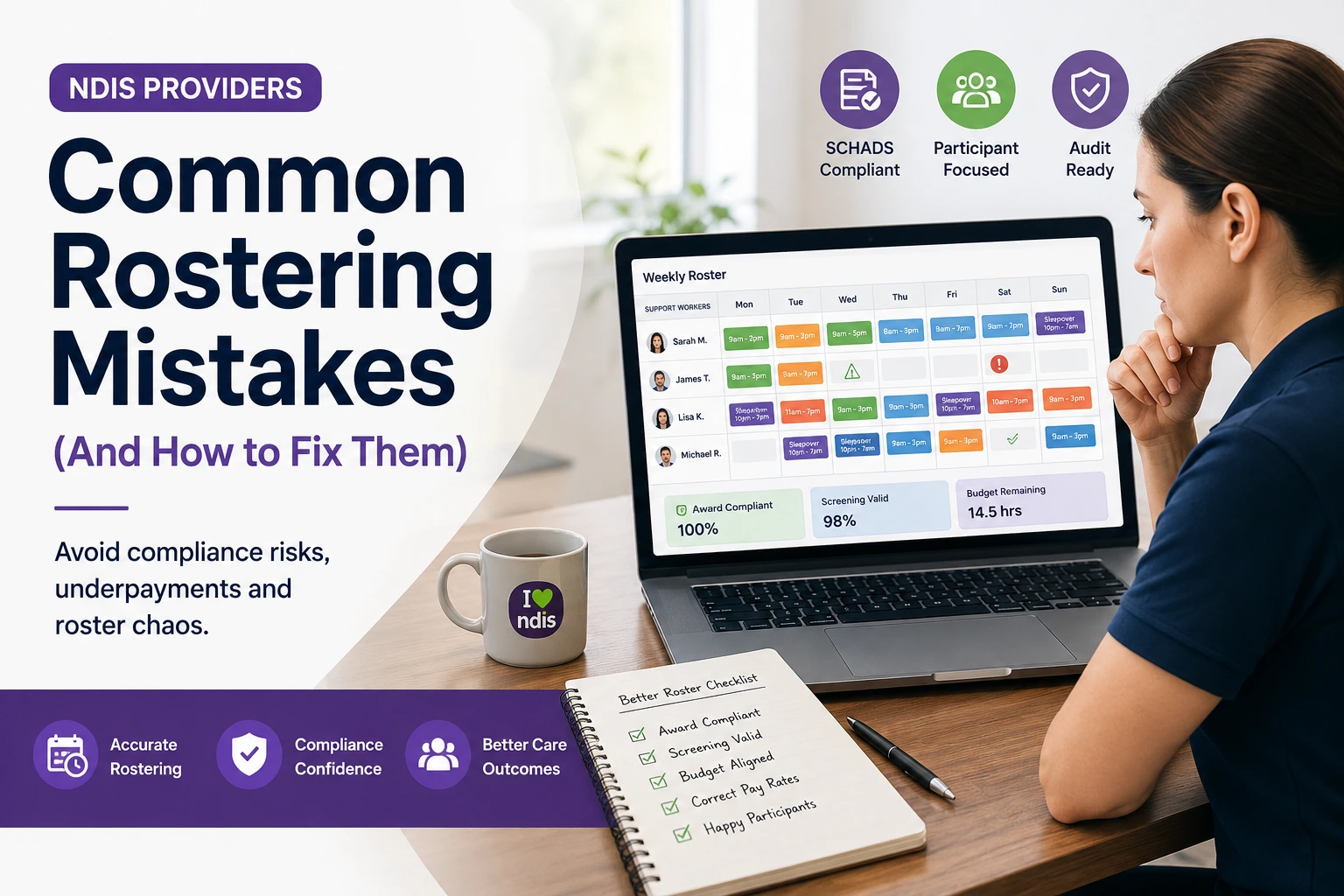
Rostering is where new providers lose the most unpaid admin time. SCHADS Award interpretation — penalty rates, broken shifts, sleepovers, overtime — is genuinely complex, and getting it wrong creates real underpayment risk.
Purpose-built NDIS rostering software checks every roster for SCHADS Award compliance automatically, applying the correct pay rates, penalties and allowances without manual calculation. That single feature routinely saves managers hours of payroll admin every week.
What automated rostering should cover:
New providers are held to the same Practice Standards as established ones from day one. There's no grace period for "still learning the system."
Compliance means meeting your legal obligations under the National Disability Insurance Scheme Act 2013, the NDIS Practice Standards and the NDIS Code of Conduct — covering safety, governance, incident management, complaints handling and documentation.
Practice Standards checklist for new providers:
Software helps most when it turns this checklist into a live dashboard rather than a folder of PDFs nobody opens until audit week.
Work through this in order. Skipping steps is how providers end up locked into a platform that doesn't fit six months later.
A few developments worth tracking as you plan your system for the next 12 months:
What is NDIS provider software used for? It manages rostering, participant records, billing, compliance and team coordination for disability service providers, replacing manual spreadsheets and disconnected apps with one connected system.
Do new NDIS providers need software before their first participant? It helps to have core systems set up before day one, particularly billing and worker screening tracking, since compliance obligations apply from the moment you're registered.
Is NDIS software required by the NDIS Commission? No specific software is mandated. What's required is meeting Practice Standards and Code of Conduct obligations — software is simply the practical way most providers achieve that at scale.
How much does NDIS provider software cost for a small business? Very small teams can often start free. Paid entry plans generally run around $8 to $9 per user per month, rising into the low tens of dollars for mid-size providers with more features.
Do I need to register for SIL supports under the new 2026 rules? If you deliver Supported Independent Living, mandatory registration applies from 1 July 2026, with continuity protected only if your application is lodged by 1 October 2026.
What happens if I miss the SIL registration deadline? You may be required to stop delivering SIL supports until registration is granted, which can mean lost revenue and participants transferring to a registered provider.
Can unregistered providers still operate in 2026? Yes, for most support types. Mandatory registration currently applies specifically to SIL and NDIS digital platform providers, not to all unregistered providers.
What is the 90-day claiming rule? From 1 December 2026, any support delivered after that date must be claimed within 90 days of the service, so billing workflows need to track this automatically.
Does NDIS software handle SCHADS Award pay calculations? Purpose-built platforms typically calculate penalty rates, broken shift allowances, sleepovers and overtime automatically as part of rostering.
What's the difference between rostering software and full NDIS provider software? Rostering software focuses on scheduling and workforce management. Full provider software adds participant case management, billing and compliance reporting in the same system.
Is my participant data safe in cloud-based NDIS software? Reputable platforms use Australian data hosting and encryption to meet Privacy Act 1988 obligations — always confirm hosting location and security certifications before signing up.
How long does NDIS provider registration take in 2026? Certification audits for higher-risk categories like SIL typically take eight to twelve months, so early preparation matters more than ever given the current audit demand.
New NDIS providers in 2026 are entering the sector under tighter registration rules, a stricter claims system, and far higher penalties than a few years ago. The right software won't remove those obligations, but it turns them into a manageable daily workflow instead of an audit-week scramble. Start with your registration groups, confirm Australian hosting and SCHADS Award support, and choose a platform that scales with you rather than one you'll outgrow in a year.
Disclaimer: NDIS rules, pricing and registration deadlines change frequently. Always verify current requirements directly on ndis.gov.au and ndiscommission.gov.au before making compliance or purchasing decisions.
Start your free 14-day trial — unlimited users, no credit card required.