How to Manage NDIS Shift Handover Between Support Workers
Key Takeaways
An NDIS shift handover is the moment one worker's knowledge becomes the next worker's. When it works, nobody notices. When it fails, a medication change, a poor night's sleep or a promised phone call simply disappears. The participant carries the risk, and your records show a gap.
This guide shows how to manage handover between support workers, step by step. It covers what to include, which format to use and how to build a process your team will follow. It also shows how a worker mobile app can keep notes, plans and incident reports in one place instead of scattered across notes and chats.
An NDIS shift handover is the transfer of key participant information, outstanding tasks and observations from the outgoing support worker to the incoming one. It usually combines a short conversation with a written record, so the next worker can continue support safely without guessing.
Handover differs from a progress note. A progress note records what happened and links it to goals. A handover looks forward. The NDIA's record keeping requirements list case notes and signed support logs among the records you must keep. Handover notes sit alongside them. The NDIS Commission's guide for supervisors also notes that some organisations put key points into handover notes, so workers assigned to a participant have the information they need.
Handovers fail when there is no standard content, no protected time and no reliable channel. Information then lives in memory, sticky notes or group chats, and nobody can confirm the next worker saw it. Casual and agency staff are the most exposed.
In its December 2024 response to the Coroners Court of Victoria following the inquest into Russell Hewat's death, disability provider Aruma described changes it had made to improve shift handovers and recognise deteriorating health. These included formal handover guidelines, a trial of electronic handover notes across 24 sites, and plans to extend the system across its 330 disability accommodation sites. Aruma also reported that its cost modelling found additional funding for a 15-minute handover was not then supported by the NDIA and would threaten provider sustainability. This was Aruma's stated position at the time, not confirmation of the current NDIS pricing rules.
Workers describe the gap too. One account shared with the Disability Royal Commission describes a shift where two workers had never met a non-verbal participant, there had been no handover, and one had to phone an off-duty colleague for information.
A strong handover covers the participant's wellbeing and any change from baseline, medication given or refused, incidents and follow-ups, plan or routine changes, outstanding tasks with owners, and requests from family or practitioners. Keep it short, factual and specific.
The NDIS Practice Standards expect support plans to say how changes to a participant's circumstances or needs will be agreed and communicated. They also expect workers to understand participants' needs and preferences where daily monitoring is required. Handover is where that happens, shift after shift.
Not everything belongs in a handover. This suggested triage helps workers decide:
| Action | Examples | How |
| Escalate now | Serious injury, suspected abuse, signs of deteriorating health, a critical medication missed | Call your coordinator or on-call manager straight away. Do not wait for handover. |
| Hand over | A poor night's sleep, a new instruction, an unfinished task, a follow-up call | Tell the next worker and write it in the handover note. |
| Record only | Routine activities and goal progress | Add to the progress note. |
A fixed format keeps handovers short and complete. Healthcare uses ISBAR: Identify, Situation, Background, Assessment, Recommendation. The Aged Care Quality and Safety Commission publishes an ISBAR resource. NDIS teams can adapt it, although the NDIS Commission does not prescribe a handover format.
Adapt it like this: who the participant is (Identify), what happened this shift (Situation), their usual baseline and plan (Background), what you observed or worry about (Assessment), and what the next worker should do or watch (Recommendation). The Aged Care Quality and Safety Commission's ISBAR resource shows the original healthcare version.
Illustrative wording: "Sam. Slept poorly and refused breakfast. He usually eats well. He looked uncomfortable when standing, and I logged it on his pain chart. Please check again by 3 pm and call the coordinator if it continues."
Set a minimum template, protect handover time, choose one channel, confirm the next worker has read it, onboard casual staff, and review a sample of handovers every week. Each step closes a common gap.
SIL homes covering 24 hours a day feel this most. Our guide to NDIS software for SIL providers explains what to look for. Weekly sampling also doubles as evidence for your audit preparation.
| Method | Strengths | Gaps |
| Paper communication book | Simple and cheap. Works at a single site. | Hard to search, easy to skip and limited audit trail. |
| Group chat | Fast and familiar. | Messages get buried, nobody confirms reading, and participant details sit on personal phones. |
| Digital shift notes in your platform | Time-stamped, searchable and linked to the participant record. | Needs training, and workers need a reliable way to capture notes without signal. |
Whichever you choose, share only what workers have permission to share. The NDIS Commission's guide for workers stresses respecting participant privacy when recording and sharing personal or confidential information.
Software helps by keeping handover pieces in one place: shift notes, plans, task items and incident reports, visible to the next worker and the office. It does not replace conversation. It makes sure what was said is recorded, findable and confirmed.
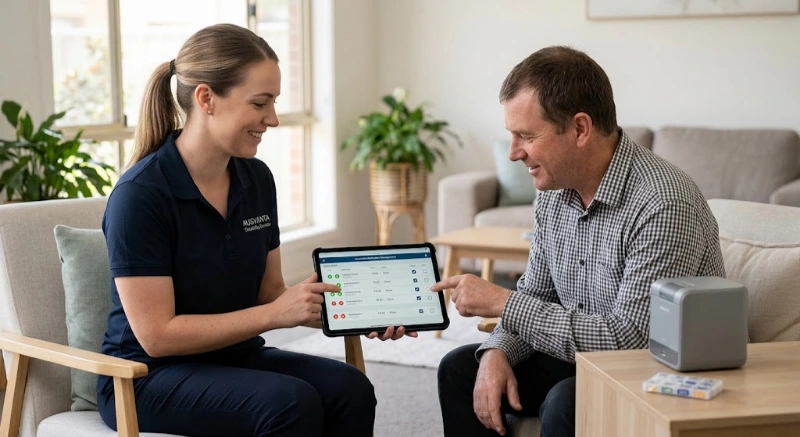
Ausvanta's worker mobile app gives support workers today's shifts, participant plans they acknowledge before support starts, task items, shift notes and on-the-spot incident reporting. Records captured without reception sync when coverage returns, and roster changes arrive as notifications. Coordinators see the same information in the web platform, so they spend less time chasing workers. The Android app is in beta and iOS is coming soon.
Good notes also protect payment, because claims need records that match the supports delivered. See how that connects in claims and billing. Features depend on your release and setup, so ask in a demo how your handover template maps to them.
Ready to see it in practice? Book a demo or start a free 14-day trial.
1. What is an NDIS shift handover?
It is the transfer of key participant information, outstanding tasks and observations from the outgoing support worker to the incoming one. It usually combines a short conversation with a written record.
2. What should a shift handover note include?
Wellbeing and changes from baseline, medication given or refused, incidents and follow-ups, plan or routine changes, outstanding tasks with owners, and messages from family or practitioners.
3. Is shift handover mandatory in the NDIS?
We found no NDIS rule that prescribes a handover format. However, the Practice Standards expect plans to set out how changes in a participant's needs are communicated, so providers need a reliable method. Confirm current requirements for your registration groups.
4. What is the difference between handover notes and progress notes?
A progress note records what happened and links it to goals. A handover note looks forward, telling the next worker what to watch, finish or ask. Providers need both.
5. Should handover be verbal or written?
Use both. A conversation allows questions and emphasis, while a written record prevents details being forgotten and gives you evidence later. Decide in advance when a face-to-face handover is required.
6. Can support workers use WhatsApp or group chats for handover?
It is risky. Messages get buried, nobody can confirm they were read, and participant details sit on personal phones. Follow your privacy policy and share only what workers have permission to share.
7. Is handover time billable?
In a December 2024 response to a Victorian coroner, provider Aruma said funding a paid 15-minute handover was not currently supported by the NDIA. Check the current NDIS pricing documents, as rules and schedules change.
8. How do you handle handover for casual or agency workers?
Give them access to the same handover records before their first shift, plus a short induction on what is expected. Aruma described this approach in its response to the coroner.
9. How can software improve NDIS shift handover?
It keeps notes, plans, tasks and incident reports in one traceable place, so the next worker and the office see the same information. It supports conversation rather than replacing it.
10. How often should we review our handover process?
Review it after any incident or near miss, whenever a plan changes significantly, and routinely by sampling a few handovers each week.
This article provides general information only and is not legal, clinical or compliance advice. NDIS rules, pricing, Practice Standards and state or territory requirements change over time and can vary by support type and circumstance. Always confirm current obligations with the NDIA, the NDIS Quality and Safeguards Commission or a qualified adviser before relying on any detail here.
Start your free 14-day trial — unlimited users, no credit card required.