Key Takeaways
Every new NDIS provider hits the same fork in the road: hire support workers directly, or subcontract the work out. Get subcontracting vs direct hiring for NDIS startups wrong, and the ATO or Fair Work Ombudsman can land you with years of backdated superannuation, penalties and a wage claim on top of what you already paid your worker. Get it right, and your workforce model becomes a genuine growth advantage instead of a compliance trap. This guide sets out what each model actually costs in 2026, how the classification tests apply specifically to disability support work, what changes under the 1 July 2026 registration reforms, and how to build a decision framework around your own participant numbers and cash flow — not a generic small-business template borrowed from construction or IT.
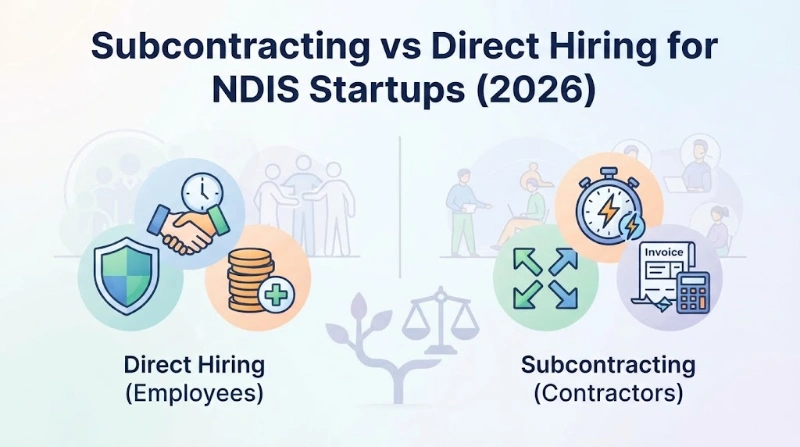
Direct hiring means engaging a worker as your employee: you withhold PAYG tax, pay superannuation, accrue leave and apply SCHADS Award conditions. Subcontracting means engaging a self-employed individual or business that holds its own ABN, invoices you for completed work, and carries its own tax, insurance and — in most cases — superannuation obligations.
On paper, the difference looks simple. In practice, it's the working relationship that decides which one you've actually got, not the label on the agreement. A worker who invoices you but turns up on a roster you set, wears your uniform, uses your equipment and can't send a replacement is very likely an employee in the eyes of the ATO and the Fair Work Ombudsman — whatever the contract calls them. This matters more in the NDIS sector than in most industries, because the NDIS Commission holds the registered or unregistered provider accountable for participant safety and service quality regardless of how the worker is engaged.
NDIS startups face a denser regulatory stack than most small businesses: Practice Standards, mandatory Worker Screening, award-based pay rules and a highly fragmented market where the average provider supports fewer than three participants. A staffing mistake here is more expensive and more visible than in most other sectors.
As at 31 March 2026, 774,456 people held an approved NDIS plan, supported by 277,376 active providers, according to the NDIA's March 2026 Quarterly Report. That works out to fewer than three participants for every provider in the scheme — one of the most fragmented service markets in Australia. Registration itself carries no fee, but the NDIS Commission's own guidance confirms that independent quality audit costs scale with the size and complexity of your organisation and are not fixed by the Commission, so it is worth getting quotes from more than one approved auditor before you budget. Getting the workforce model wrong early is expensive twice over: once in lost time preparing for audit, and again if a regulator later reclassifies your workers.
Direct hiring suits NDIS startups delivering ongoing, rostered, one-to-one or in-home support where continuity of relationship matters to the participant, where you need to direct exactly how and when work is done, and where you can commit to steady rostered hours.
Once you directly engage staff, you take on the full set of employer duties: record keeping (rosters, payroll and insurance records, generally for at least seven years), PAYG withholding, superannuation, work health and safety, and screening and clearances before a worker starts.
NDIS's own guidance on directly engaging staff sets these out in detail for self-managing participants, and the same underlying employer obligations apply when a provider organisation takes someone on as staff rather than as a contractor.
Base pay is only part of the bill. Three mandatory components alone add up quickly: the Superannuation Guarantee is 12% of ordinary time earnings from 1 July 2025; the National Employment Standards minimum of four weeks' annual leave equates to roughly 8% of a full-time employee's paid hours; and the minimum 10 days' personal/carer's leave adds a further 4% or so. Add those three NES- and super-mandated entitlements together and on-costs commonly land in the region of a quarter of base wage before workers compensation insurance premiums (which vary by state and industry) and payroll administration time are even counted. Rather than treat any single percentage as fixed, model your own on-costs against your state's workers compensation rates and current SCHADS classification.
On top of that, the Fair Work Commission's 2026 Annual Wage Review lifted modern award minimum rates, including the SCHADS Award, by 4.75% from 1 July 2026. A separate Fair Work Commission gender-based undervaluation decision (handed down 1 June 2026) additionally lifts pay for Home Care Employees — Disability Care (Schedule E) by approximately 15%, with the initial increase applying from 1 December 2026 (Fair Work Ombudsman), ahead of a full classification restructure that replaces Schedules B, C, E and F from 1 October 2027. Providers budgeting on last year's SCHADS rates will be under-costed within months.
| Direct Hiring | Pros | Cons |
| Control | You direct how, when and where the work is done | You carry full WHS and supervision responsibility |
| Continuity | Participants keep the same familiar worker | Harder to scale the roster down quickly if funding drops |
| Cost | Predictable, budgetable wage costs | Mandatory on-costs (super, leave, insurance) add roughly a quarter on base pay before payroll admin |
| Compliance | Clear employer/employee audit trail for the NDIS Commission | Full award, PAYG and leave administration burden sits with you |
Subcontracting suits NDIS startups covering short-term participant surges, accessing a specialist skill they don't have in-house, testing a new service line before committing to a hire, or filling an after-hours or geographic gap — provided the arrangement is genuinely one of independence, not disguised employment.
A sub contract in the NDIS context should flow down the same obligations you owe under your service agreement with the participant: confidentiality of participant information, quality and safety standards, and reporting timeframes. Beyond scope and payment terms, an NDIS-specific sub contract needs a few things that a generic small-business template often misses.
| Subcontracting | Pros | Cons |
| Flexibility | Scale up or down with participant numbers, no severance process | Less day-to-day control over methods and timing |
| Speed | Can activate specialist or overflow cover quickly | Continuity for the participant depends on one individual's availability |
| Cost | No leave loading; genuine contractors may cover their own super | Sham contracting risk if the relationship looks like employment |
| Admin | Simpler payroll — you pay an invoice, not a payslip | You still need Taxable Payments Annual Report (TPAR) lodgement with the ATO |
Regulators look at the whole working relationship, not the label in your contract. Seven factors matter most: who controls how and when the work is done, whether the worker runs their own business, how they're paid, whether they can delegate, who supplies the tools, who carries the risk, and whose goodwill the work builds.
This is the step most staffing guides skip, and it's the single most expensive mistake an NDIS startup can make. Calling someone a contractor doesn't make them one. Courts weigh the whole relationship against a well-established set of indicators, applied here to disability support work specifically.
| Test | Points to an employee | Points to a genuine contractor |
| Control | You set exact hours, shifts and how tasks are done | They control how and when the work is completed |
| Integration | They present as part of your business/team | They run their own separate NDIS-related business |
| Payment | Paid for time worked, by the hour or shift | Paid a fixed fee for a defined result |
| Delegation | Must do the work personally, can't send a replacement | Can delegate or subcontract the work to someone else |
| Tools & equipment | You provide phone, car, uniform, devices | They supply their own tools and equipment |
| Risk | You fix mistakes and carry the cost of errors | They carry their own insurance and fix their own errors |
| Goodwill | Their work builds your business's reputation | Their work builds their own business's reputation |
The Fair Work Ombudsman and ATO run joint compliance activity targeting sham contracting, and both regulators warned in March 2026 guidance that they won't hesitate to pursue it in any sector. Under the Fair Work Act, the maximum penalty per contravention is $19,800 for an individual, $99,000 for a business with fewer than 15 employees, and for larger businesses, the greater of $495,000 or three times the underpayment. On top of that sits a PAYG withholding penalty and a Superannuation Guarantee Charge — which can include an additional charge of up to 200% — plus interest and an administration fee, calculated separately by the ATO.
A lot of new providers assume engaging a contractor avoids superannuation altogether. Since 1 July 2022, that threshold-based exemption was abolished, and the ATO's guidance on paying super to contractors makes clear that a worker paid wholly or principally for their labour, who can't delegate the work, is treated as an employee for superannuation purposes — regardless of ABN status. Because most one-to-one NDIS support work is paid for time and personal labour rather than a fixed-price result, a large share of "contractor" support workers are legally owed the 12% Superannuation Guarantee anyway. Budgeting on the assumption that subcontracting removes the super bill is one of the fastest ways for a startup to end up with a retrospective Superannuation Guarantee Charge.
Work health and safety duties, NDIS Worker Screening obligations for risk-assessed roles, and incident-reporting accountability to the NDIS Commission all sit with the provider regardless of whether the worker is an employee or a subcontractor.
Under Safe Work Australia's model laws, anyone who is a person conducting a business or undertaking (PCBU) owes a primary duty of care to workers, and that duty exists whether the worker is your employee or an engaged subcontractor working under your direction. Similarly, the NDIS Worker Screening Check is required for anyone in a risk-assessed role — direct service delivery or more than incidental contact with a participant — and that requirement doesn't relax just because someone invoices you instead of receiving a payslip. Using an external staffing arrangement changes how you meet your obligations; it does not change what those obligations are. Building a documented, audit-ready trail of screening, induction and shift records is what keeps this manageable — see how incident management and rostering records work together to satisfy an NDIS Commission review.
From 1 July 2026, the transition to mandatory registration begins for Supported Independent Living (SIL) providers and NDIS platform providers, bringing more of the market under formal Practice Standards audit — which raises the bar for documented workforce records no matter which staffing model a provider uses.
The NDIS Commission's own announcement confirms that every provider delivering SIL or operating as a platform provider will be subject to independent audits, suitability assessments, reporting requirements and worker screening checks as part of this transition. Detailed transition arrangements were still being finalised at time of writing, so check current Commission guidance for your specific timeline. Directionally, though, a wider registration net means more providers now need audit-ready evidence: current screening clearances, rosters that show who actually delivered a shift, and incident registers that satisfy NDIS Commission timelines. Startups building this from day one — rather than retrofitting it before an audit — have a real head start, whichever mix of employees and subcontractors they end up running.
Direct employment is paid as wages plus mandatory on-costs (super, leave, insurance) calculated on hours worked. Genuine subcontracting is typically billed as an invoice — a flat project fee, a day rate, or an hourly rate the contractor sets themselves — with no employer on-costs, unless the contractor is owed superannuation under the labour rules described below.
There's no reliable, independently verified benchmark for what NDIS providers pay outsourced or subcontracted support across the sector — rates are negotiated individually and vary enormously by state, service type and the individual or firm involved. Treat any specific dollar figure you see quoted online (including by outsourcing providers marketing their own services) as one party's indicative pricing, not an industry average, and build your own model from these fixed components instead:
There's no single right answer for every provider. The safer approach is to choose role by role rather than organisation-wide: map the actual nature of the work, honestly test it against the seven classification factors, model the true 12-month cost both ways, and document the decision in writing before the worker starts.
Whichever mix you choose, the NDIS Commission expects the same thing from you: proof of who delivered each shift, that they were screened and qualified to do it, and that any incident was captured and escalated on time. A platform built around this makes the mix easier to run, not harder.
If you're weighing up your workforce model right now, start a free 14-day trial to see how Ausvanta keeps rostering, screening and compliance records straight across a mixed team, or get in touch if you'd like to talk it through first.
1. What's the main difference between subcontracting and direct hiring in the NDIS sector?
Direct hiring makes a support worker your employee, with PAYG tax, superannuation, leave and SCHADS Award conditions applied. Subcontracting engages a self-employed worker or business that invoices you and carries its own tax and insurance — but only if the working relationship is genuinely independent.
2. Can NDIS providers use subcontractors instead of employees?
Yes, providers can engage subcontractors for genuine project or specialist work. The risk is misclassification: if the subcontractor is directed, rostered and integrated like staff, the ATO and Fair Work Ombudsman can treat the arrangement as employment regardless of the contract.
3. Do NDIS subcontractors need a Worker Screening Check?
Yes. Anyone performing a risk-assessed role — direct service delivery or more than incidental contact with a participant — needs a current NDIS Worker Screening clearance, whether they are an employee or an engaged subcontractor.
4. Is superannuation payable to NDIS contractors?
Often, yes. Since 1 July 2022, a contractor paid mainly for their labour who can't delegate the work is treated as an employee for superannuation purposes, currently at the 12% Superannuation Guarantee rate. Most one-to-one support work falls into this category.
5. What are the penalties for sham contracting in Australia?
Under the Fair Work Act, the maximum penalty per contravention is $19,800 for an individual, $99,000 for a business with fewer than 15 employees, and for larger businesses, the greater of $495,000 or three times the underpayment — plus separate ATO penalties for PAYG and superannuation shortfalls.
6. How much does it cost to directly employ an NDIS support worker compared with subcontracting?
Direct employment adds mandatory on-costs — 12% superannuation plus NES annual and personal leave accrual, commonly totalling around a quarter of the base SCHADS wage before insurance and payroll admin. Subcontracting is billed as an invoice instead, but that gap narrows if the contractor is legally owed superannuation under the labour-only rules. There's no reliable sector-wide benchmark for subcontracted rates, so model both against your own state and service type.
7. Does the SCHADS Award apply to subcontractors?
The SCHADS Award sets minimum pay and conditions for employees, not genuine independent contractors. However, if a "subcontractor" is legally an employee in substance, SCHADS Award rates and entitlements apply retrospectively, along with back-payment exposure.
8. What should an NDIS subcontractor agreement include?
At minimum: a defined scope of work, payment terms, insurance requirements (public liability, and professional indemnity where relevant), confidentiality over participant information, a non-solicitation clause, and clear termination and handover terms.
9. Do the 1 July 2026 NDIS registration reforms affect staffing choices?
Yes, indirectly. From 1 July 2026, mandatory registration begins transitioning in for Supported Independent Living and platform providers, per the NDIS Commission, bringing more providers under formal Practice Standards audit and increasing the need for documented, audit-ready workforce records regardless of the staffing model used.
10. Should a new NDIS provider start with subcontractors or employees?
There's rarely a single right answer. Most successful NDIS startups run a documented hybrid: employees for core, ongoing rostered support where continuity matters, and subcontractors for genuine short-term, specialist or overflow work — decided role by role, not organisation-wide.
Start your free 14-day trial — unlimited users, no credit card required.