
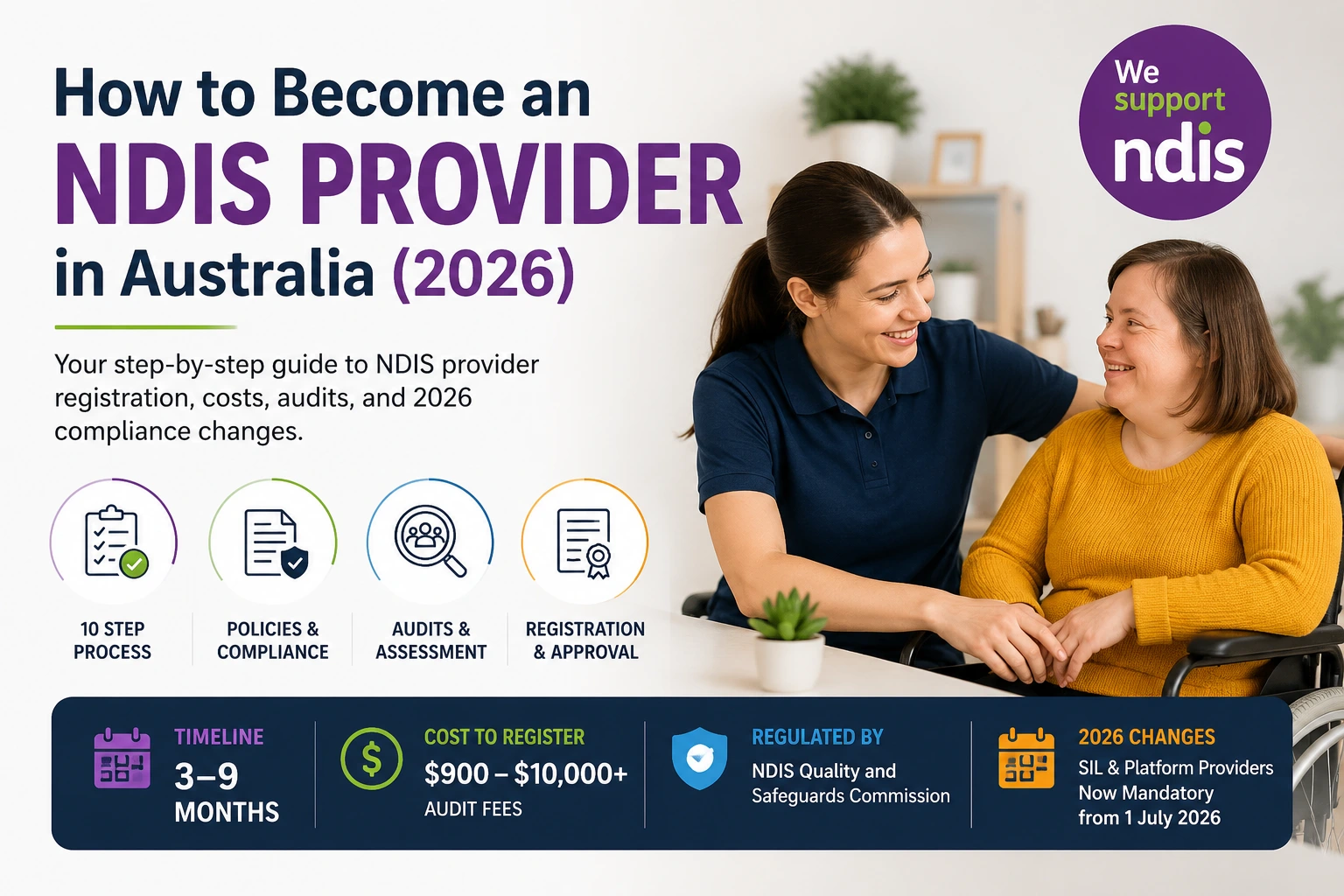
If you want to become an NDIS provider, you need to work through a defined process run by the NDIS Quality and Safeguards Commission: confirming your eligibility, choosing the right registration groups, building compliant policies, completing an independent audit, and passing a suitability assessment. It typically takes three to nine months and costs vary mainly with the audit, not the application itself. This guide breaks the process into ten practical steps, with realistic timeframes, costs and the mistakes that most often delay approval.
An NDIS provider is a person, business or organisation that delivers supports and services funded under a participant's NDIS plan. Providers can be sole traders, partnerships, companies or not-for-profits, and they can be either registered with the NDIS Commission or unregistered. Both are bound by the NDIS Code of Conduct, but only registered providers can accept referrals from NDIA-managed participants.
NDIS providers deliver a wide range of supports — personal care, allied health and therapy, assistive technology, home modifications, transport, support coordination and Supported Independent Living (SIL) — and each of these sits within a specific NDIS registration group.
Registering as an NDIS provider can benefit a wide range of individuals and organisations that deliver disability support services. While registration isn't mandatory for every provider, it is essential for certain support categories and allows you to work with NDIA-managed participants.
The following professionals and businesses commonly register as NDIS providers:
The core difference comes down to who you can work with and how much oversight applies. Registered providers have passed an independent audit against the NDIS Practice Standards and can deliver supports to self-managed, plan-managed, and NDIA-managed participants. Unregistered providers can only work with self-managed or plan-managed participants, and cannot accept NDIA-managed clients.
| Factor | Registered Provider | Unregistered Provider |
| Participants you can serve | Self-managed, plan-managed and NDIA-managed | Self-managed and plan-managed only |
| Independent audit required | Yes — verification or certification | No formal audit, but Code of Conduct still applies |
| Listed on Provider Register | Yes | No |
| Worker screening | Mandatory for key personnel and risk-assessed roles | Required for some support types and sole traders |
| Ongoing obligations | NDIS Practice Standards, incident reporting, mid-term/renewal audits | NDIS Code of Conduct, complaints handling |
The NDIS Quality and Safeguards Commission (NDIS Commission) is the independent Australian Government agency responsible for regulating NDIS providers, and it operates separately from the National Disability Insurance Agency (NDIA), which manages participant plans and funding. The Commission sets the NDIS Practice Standards, manages the registration and audit process, investigates complaints, and can issue banning orders against providers or individuals who breach their obligations.
Below is the practical sequence most new providers follow, from initial eligibility checks through to your first day delivering registered supports.
Before applying, you need an Australian Business Number (ABN), a clear business structure (sole trader, partnership, company or not-for-profit), and evidence that you can actually deliver the supports you're applying to provide. The Commission will assess the suitability of your organisation and every key personnel — directors, executives, and anyone with significant influence over the business — including any past convictions, banning orders or compliance history.
NDIS supports are organised into registration groups (also called classes of support) — for example, therapeutic supports, household tasks, community participation, and Supported Independent Living. The groups you select determine which NDIS Practice Standards you'll be audited against and whether you need a verification or certification audit. It's generally sensible to register only for the groups that match what you deliver now, and expand later once your systems are established, since adding groups unnecessarily increases audit scope and cost.
This is usually the most time-consuming stage. You'll need documented policies and procedures covering areas such as:
Some providers develop these documents in-house; others engage a consultant to speed the process. Either way, the NDIS Commission expects you to be substantially involved in preparing your own application, even if you use outside help.
PRODA (Provider Digital Access) is the Australian Government's identity verification system, and you cannot access the NDIS Commission's application portal without it. You'll verify your identity using documents such as a passport, Medicare card or driver's licence, then create or link your organisation to your PRODA account.
Log in to the NDIS Commission Applications Portal using your PRODA credentials and select the option to apply as a new NDIS provider. You'll provide your organisation's details, corporate structure, locations, and key personnel information, then select the registration groups you identified in Step 2. Note that once you start an application, you must complete it within 60 days or it will be deleted and you'll need to start again.
As part of the application, you'll complete a self-assessment against the NDIS Practice Standards relevant to your chosen registration groups, providing evidence to support each response. This self-assessment forms the basis of what your independent auditor will later verify.
Once you submit your application, the Commission emails you an Initial Scope of Audit document confirming whether you need a verification or certification audit, and outlining your registration groups. You are responsible for engaging an Approved Quality Auditor (AQA) from the Commission's published list — it's worth requesting two or three quotes, since audit pricing is set by auditors, not the Commission, and varies with your size, participant numbers and registration groups.
| Verification Audit | Certification Audit | |
| Applies to | Lower-risk, lower-complexity supports | Higher-risk or more complex supports |
| Format | Desktop document review only | Document review plus an on-site visit and interviews with staff and participants |
| Focus areas | Human resources, incidents, complaints, risk | Core Module plus relevant Supplementary Modules |
| Typical cost | Roughly $900–$1,800 | Roughly $3,000–$10,000+, depending on scope |
If your application includes even one registration group that requires certification, your entire audit moves to the certification pathway — so it's worth checking each group's risk classification carefully before you apply.
Your auditor submits their report to the NDIS Commission, which reviews it alongside a broader suitability assessment before making a final decision. If successful, you'll receive a Certificate of Registration outlining your approved registration groups, registration period and any conditions, and your details will be published on the NDIS Provider Register. If your application is refused, you have three months to appeal the decision.
Once registered, you'll operate through the NDIS Commission's Provider Portal (accessed via PRODA) for service bookings, payment claims and compliance reporting. New providers may also need to complete elements of a quality audit involving participant engagement within a set timeframe after starting service delivery.
There is no fee to register with the NDIS Commission itself — your main direct cost is the independent audit, which you pay to your chosen Approved Quality Auditor. As a broad guide, small providers typically budget $900–$1,800 for a verification audit and $3,000–$10,000 or more for a certification audit, depending on the number of registration groups, sites and participants involved. On top of the audit, factor in ongoing costs such as NDIS Worker Screening Checks (state-set fees, roughly $107–$156 per worker, valid for five years), professional indemnity and public liability insurance, and staff training.
Most sources in the sector put the realistic timeline at three to nine months from starting your application to receiving your Certificate of Registration, though it can extend beyond 12 months for larger organisations or complex certification audits. The single biggest driver of delay is being under-prepared for the audit — providers who have their policies, evidence and staff training ready before they apply generally move through the process faster than those building documentation reactively.
Every key personnel member and anyone in a risk-assessed role must hold a valid NDIS Worker Screening Check, issued through your state or territory screening unit — this is separate from, and more specific than, a standard police check. Costs and processing times vary by jurisdiction, and clearances are typically valid for five years. Delays in obtaining worker screening clearances are one of the most common reasons applications stall, so it's worth starting this process early and well before you submit your application.
The NDIS Amendment (Integrity and Safeguarding) Act 2026 received Royal Assent on 8 April 2026 and introduces stronger enforcement powers, expanded banning orders, and new penalties for delivering supports that require registration without holding it. From 1 July 2026, registration became mandatory for providers delivering Supported Independent Living (now under registration group 0138) and for platform-based providers that connect participants with support workers via an app or website. Providers who were unregistered and already delivering SIL are required to lodge their application by 1 October 2026 and may continue delivering services while their application is in progress.
Under the amended Act, providing a support that requires registration without holding it is a criminal offence, and legal commentary on the reforms cites a maximum penalty of up to two years' imprisonment or a fine of 120 penalty units (currently around $39,600), or both, with civil penalties for serious contraventions able to reach 10,000 penalty units (currently around $3.3 million). Reported figures vary across industry sources, so providers should confirm the current penalty settings directly with the NDIS Commission or seek independent legal advice rather than relying on a single secondary source.
The government has flagged further expansion of mandatory registration to personal care and daily living supports from around July 2027, though this has not yet been legislated — providers in these categories should monitor NDIS Commission announcements rather than assume a fixed date.
Registration is not a one-off event. Providers who completed a certification audit face a mid-term audit at 18 months, and full registration is typically renewed every three years with a further audit. You're also required to report certain incidents to the NDIS Commission — reportable incidents such as abuse, neglect or unexplained death within 24 hours, and other incidents involving harm or risk within five business days. Ongoing compliance also means keeping worker screening current, maintaining accurate payment claim records, and reviewing your policies as the NDIS Practice Standards and Rules are updated.
Whether you're preparing for your first audit or managing renewals as a registered provider, the administrative load is real — tracking worker screening expiry dates, matching payment claims to service bookings, logging incidents within the required timeframes, and keeping policy evidence audit-ready. Purpose-built NDIS provider software can bring worker compliance, rostering, invoicing and incident records into one system, reducing the manual tracking that causes most compliance gaps. If you're weighing up how to structure your operations ahead of registration, it's worth exploring how a platform like Ausvanta is designed specifically around NDIS Practice Standards requirements, before you lock in your internal processes.
Do I need to be registered to work as an NDIS provider?
No — you can operate as an unregistered provider serving self-managed and plan-managed participants. However, registration is mandatory for certain support types, including Supported Independent Living and platform-based services from 1 July 2026, and registration is required if you want to work with NDIA-managed participants.
How much does it cost to become an NDIS provider?
Registering with the NDIS Commission itself is free. Your main cost is the independent audit, typically $900–$1,800 for a verification audit and $3,000–$10,000+ for a certification audit, plus worker screening fees and insurance.
How long does NDIS provider registration take?
Most providers should budget three to nine months from starting their application to receiving a Certificate of Registration, though complex certification audits can take longer.
What is the difference between a verification and certification audit?
A verification audit is a desktop document review for lower-risk supports. A certification audit adds an on-site visit and interviews with staff and participants, and applies to higher-risk or more complex supports.
What is PRODA and why do I need it?
PRODA (Provider Digital Access) is the Australian Government's identity verification system. You must create and verify a PRODA account before you can access the NDIS Commission Applications Portal.
What are NDIS registration groups?
Registration groups are categories of NDIS supports and services, such as therapeutic supports, household tasks, or Supported Independent Living. The groups you apply for determine your audit type and the NDIS Practice Standards you're assessed against.
Do I need an ABN to become an NDIS provider?
Yes, an Australian Business Number is required before you can apply for NDIS provider registration.
What is an NDIS Worker Screening Check?
It's a national check assessing whether a person working with people with disability poses a risk to participants. It's separate from a police check and is mandatory for key personnel and workers in risk-assessed roles.
Can I add more registration groups later?
Yes. You can apply to expand your registration after you're approved, though adding higher-risk groups may trigger an out-of-cycle audit.
What happens if my application is refused?
You'll be notified in writing of the decision and reasons. You have three months to appeal if you disagree with the outcome.
Who regulates NDIS provider registration?
The NDIS Quality and Safeguards Commission, an independent Australian Government agency separate from the NDIA, manages provider registration, audits and compliance.
Is registration now mandatory for Supported Independent Living providers?
Yes. From 1 July 2026, SIL providers and platform-based providers must be registered, with a 1 October 2026 application deadline for providers who were previously unregistered.
How often do registered providers need to be re-audited?
Providers who completed a certification audit face a mid-term audit at 18 months, and registration is generally renewed with a full audit every three years.
Registering as an NDIS provider involves far more than completing an application. You'll need to manage audits, worker screening, incident reporting, participant records, rostering, invoicing, and ongoing compliance. Using purpose-built software from the beginning can help reduce administrative work and keep important records organised. If you're comparing systems, see how Ausvanta supports providers with compliance, rostering, invoicing, and participant management.
Start your free 14-day trial — unlimited users, no credit card required.