
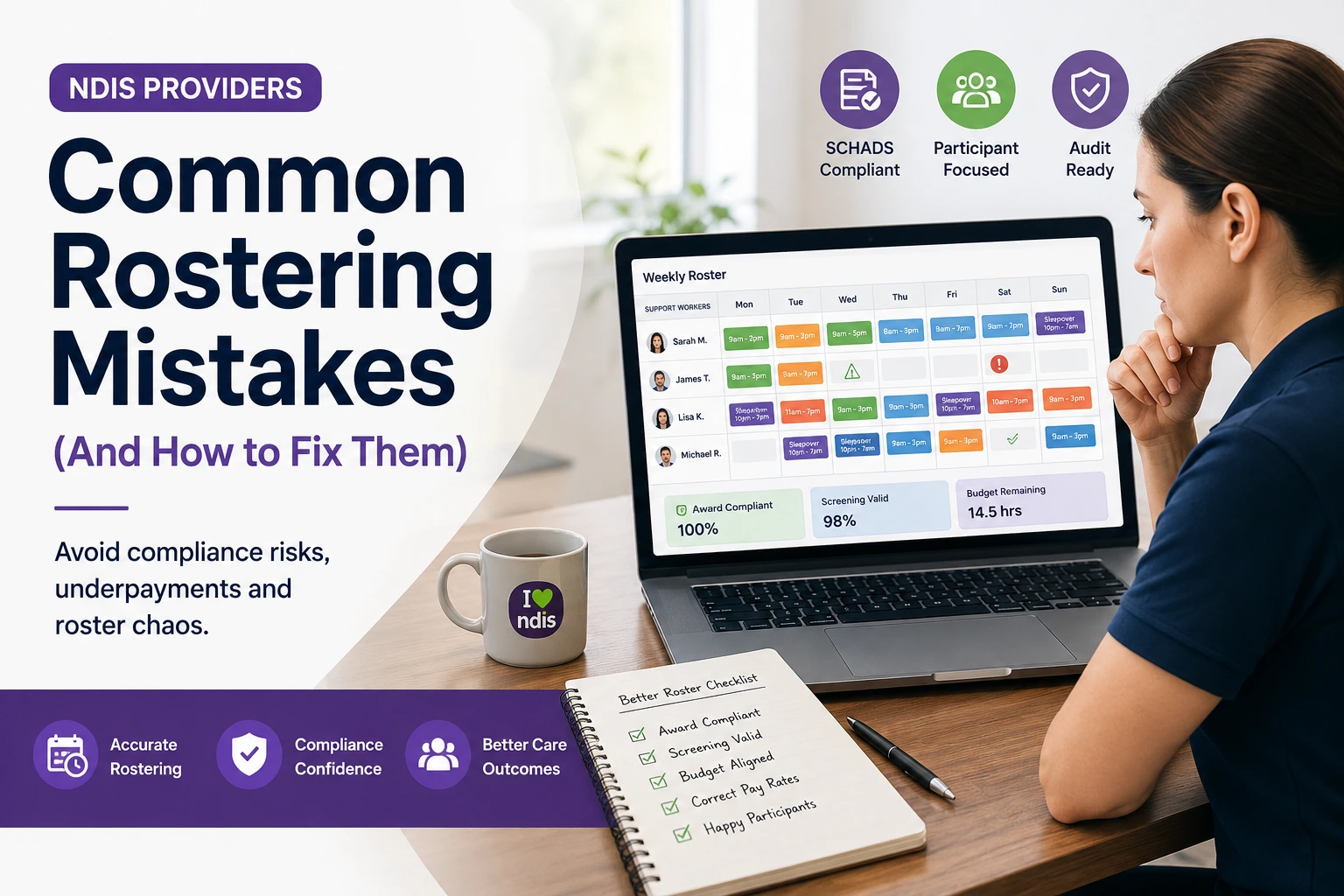
A roster looks simple on the surface: names, shifts, times. But for an NDIS provider, that grid is quietly connected to everything else in the business — participant funding, worker pay, compliance evidence, and staff retention. Get it wrong, and the damage rarely shows up straight away. It surfaces weeks later as an underpayment claim, a rejected claim in the myplace portal, or a participant complaint about a support worker who didn't turn up. Rostering mistakes NDIS providers make tend to follow familiar patterns — and most of them are preventable once you know where to look. This guide walks through the eight most common ones, why they happen, and what a better process looks like in practice.

| Quick answer:Rostering mistakes cost NDIS providers in three ways: financial (underpayments, rejected claims), regulatory (breaches of the NDIS Practice Standards and the SCHADS Award), and human (roster gaps that disrupt participant care and burn out staff). Because rosters sit at the intersection of funding, payroll and compliance, a single scheduling error can ripple into all three areas at once. |
Before diving into each issue, here's a quick overview of the most common rostering mistakes, the risks they create, and how modern NDIS software helps prevent them.
| Mistake | Risk | Solution |
|---|---|---|
| Using spreadsheets | Payroll errors | Purpose-built NDIS rostering software |
| Wrong SCHADS Award interpretation | Employee underpayments | Automated award interpretation engine |
| Missing worker screening checks | Compliance breaches | Automatic expiry alerts |
| Disconnected rostering and billing | Claim rejections and delayed payments | Integrated rostering and billing platform |
The Social, Community, Home Care and Disability Services Industry Award covers more than a quarter of a million workers across disability, home care and community services — and it's widely regarded as one of the most complex awards in the Fair Work system, with multiple streams, classification levels and penalty combinations that interact in non-obvious ways.
The Fair Work Ombudsman has made the care sector a priority enforcement area. In the 2024–25 financial year alone, it recovered more than $30 million in underpayments from the care sector. Since January 2025, intentional underpayment has also been a criminal offence in Australia, carrying penalties of up to 10 years' imprisonment for individuals and fines of at least $7.825 million or three times the underpayment amount for companies. Most underpayments in this sector aren't deliberate — they come from rostering and payroll processes that were never built to handle SCHADS-level complexity.
| Quick answer:Spreadsheets can't apply award rules, flag qualification expiries, or reconcile a roster against a participant's plan budget. As a provider grows past a handful of staff, manual rostering shifts from 'workable' to a source of hidden compliance and financial risk. |
A spreadsheet is a passive record. It will hold whatever you type into it, correct or not. It won't tell you that a shift breaches the SCHADS Award's minimum 10-hour break between shifts, that a worker's screening check expired last month, or that a client's plan is about to run out of funded hours. Those checks depend entirely on someone remembering to do them manually, every single time — which is difficult to sustain once a roster grows past a small team.
This doesn't mean every provider using a spreadsheet today is at immediate risk. It means the risk is invisible until an audit, a complaint, or a Fair Work investigation forces it into view.
| Quick answer:Weekend, evening, overtime and public holiday penalty rates under the SCHADS Award interact in thousands of possible combinations. Manually calculating them shift by shift is one of the most common sources of underpayment in the sector. |
The SCHADS Award sets out roughly eight classification levels across four streams, with penalty rates, casual loadings, and allowances layered on top of ordinary hourly rates. Saturday work, Sunday work, public holidays, evening and night shifts each attract different loadings, and a casual worker's loading is calculated on top of the applicable penalty rather than replacing it.
A common failure pattern is applying the wrong stream or schedule altogether — for example, rostering a disability support worker under the general Social and Community Services stream instead of the Home Care stream that actually applies to their work, which produces a systemic underpayment that compounds every pay cycle rather than a one-off error.
Correcting a systemic misclassification after the fact — often called a payroll remediation program — typically requires reviewing at least six years of pay records under the Fair Work Act's limitation period, which is a far more expensive exercise than getting the classification right at the rostering stage.
| Quick answer:Broken shifts and sleepover shifts are two of the most misunderstood entitlements under the SCHADS Award. Both have strict eligibility rules, minimum payment thresholds, and allowances that are easy to miss when rosters are built manually. |
A broken shift under the SCHADS Award is one split into two or three periods of paid work, separated by unpaid breaks, with a maximum 12-hour span between the first start time and the last finish time — beyond which double time applies. Each work period also carries its own minimum payment (generally two hours), and broken shifts attract a separate allowance on top of ordinary pay. Crucially, broken shifts only apply to home care and social-and-community-services employees performing disability work — not to every SCHADS employee — so applying the arrangement to the wrong role is itself a compliance gap.
Sleepover shifts carry their own complexity, and the rules have shifted recently. Following the Full Federal Court's 2026 decision in Fair Work Ombudsman v Jats Joint Pty Ltd, and a subsequent Fair Work Commission determination, shift penalties for periods worked immediately before or after a sleepover are now calculated separately for each period of active work, rather than treating the sleepover and surrounding shifts as one continuous block. Providers who built their rosters and payroll around the older interpretation need to review those settings against the current position, since the changes took effect from the first full pay period on or after 1 June 2026.
| Quick answer:NDIS Worker Screening Checks are valid for five years. Providers who track expiries manually — in a spreadsheet or a diary note — routinely discover lapses only after a worker has already been rostered onto shifts, which is a direct Practice Standards breach. |
The first wave of five-year NDIS Worker Screening Checks began expiring from 1 February 2026, which means many providers are now managing renewal deadlines at scale for the first time. The NDIS Practice Standards require providers to demonstrate active workforce management — documented screening clearances, qualification records, and evidence that only appropriately checked and qualified workers were rostered onto each shift. A roster that doesn't cross-reference worker credentials at the point of assignment relies entirely on a coordinator remembering to check manually, shift by shift.
| Quick answer:The SCHADS Award requires at least 10 hours off between the end of one shift and the start of the next. Manually built rosters — especially ones adjusted last-minute to cover call-outs — regularly breach this without anyone noticing until a complaint or audit surfaces it. |
Rest break breaches are easy to create by accident. A worker finishing a late shift and being asked to cover an early start the next morning can fall short of the 10-hour minimum by an hour or two — a gap that's simple to miss on a manual roster but straightforward for rostering software to flag automatically before the shift is confirmed.
| Quick answer:When a roster is built without visibility into a participant's approved plan budget or Roster of Care, providers risk over-delivering unfunded hours, under-delivering committed supports, or triggering plan manager disputes over mismatched claims. |
For Supported Independent Living (SIL) arrangements in particular, the roster is meant to mirror the approved Roster of Care. Where the two drift apart — because the roster was updated informally but the Roster of Care wasn't resubmitted — plan managers and support coordinators can raise formal disputes, and providers can find themselves delivering support hours that funding doesn't actually cover.
| Quick answer:When rosters live in a static document rather than a live system, last-minute changes, sick-day cover, and shift swaps get communicated through phone calls, texts and group chats — creating version confusion about who is actually rostered where. |
Disability support work runs on flexibility: participants change appointments, workers call in sick, and support needs shift day to day. A roster that isn't visible in real time to everyone involved forces coordinators to manually chase updates and support workers to double-check whether the version they're looking at is still current. That gap is also where care continuity breaks down — a participant left without confirmed support because a shift swap didn't reach everyone who needed to know.
| Quick answer:When rostering and NDIS billing sit in disconnected systems, every shift has to be re-entered or reconciled manually before it can be claimed — multiplying the chance of claim errors and slowing down cash flow. |
Claims submitted through the myplace provider portal need to map cleanly back to the support actually delivered — the right support item, the right duration, the right participant. When rostering and billing are handled in separate tools, that mapping happens manually, which is both slower and more error-prone than a system where a completed shift flows directly into a claim.
None of these mistakes come from a lack of care — they come from asking manual processes to hold more complexity than they're designed for. Purpose-built NDIS rostering software addresses each of the patterns above by design rather than by reminder: award interpretation calculates penalty rates, broken shifts and sleepover allowances automatically at the point a shift is created; screening and qualification expiries are flagged before a worker can be rostered; rosters stay visible in real time to coordinators and support workers; and completed shifts flow through to billing without manual re-entry.
Ausvanta builds NDIS software around exactly this problem — rostering that's built for the sector's compliance requirements from the ground up, rather than a generic scheduling tool adapted after the fact.
Run through this list against your current roster. If more than two or three items are a 'no' or 'not sure', it's worth reviewing your process before your next audit or pay run.
What is the most common rostering mistake NDIS providers make?
The most common mistake is relying on manual or spreadsheet-based rostering, which can't automatically apply SCHADS Award penalty rates, flag rest-break breaches, or track worker screening expiries — leaving providers to catch errors after the fact rather than before a shift is confirmed.
How does the SCHADS Award affect NDIS rostering?
The SCHADS Award sets minimum pay rates, penalty rates, broken shift rules, sleepover allowances and minimum rest breaks for most disability support workers. Because it has multiple streams, classification levels and thousands of possible pay combinations, it directly shapes how a compliant roster needs to be built.
What is a broken shift under the SCHADS Award?
A broken shift is a shift split into two or three periods of paid work with unpaid breaks in between, with a maximum 12-hour span from start to finish and a minimum payment for each work period. Broken shifts only apply to home care and social-and-community-services employees performing disability work.
How long are NDIS Worker Screening Checks valid?
NDIS Worker Screening Checks are valid for five years. The first wave of checks began expiring from 1 February 2026, meaning many providers are managing large-scale renewals for the first time and need a system to track expiry dates.
What is the minimum rest break between shifts under SCHADS?
Employees covered by the SCHADS Award are entitled to at least 10 hours off between finishing one shift and starting the next. Rosters built or adjusted manually — particularly last-minute changes to cover absences — can breach this without anyone noticing.
Can NDIS providers be penalised for rostering mistakes?
Yes. The Fair Work Ombudsman actively audits and investigates the care sector, and recovered over $30 million in underpayments from the sector in the 2024–25 financial year alone. Since January 2025, intentional underpayment is also a criminal offence in Australia.
How do sleepover shifts affect penalty rates?
Following a 2026 Full Federal Court decision and a subsequent Fair Work Commission determination, shift penalties for work performed immediately before or after a sleepover are now calculated separately for each period of active work, rather than treating the whole period as one continuous shift. The change applies from the first full pay period on or after 1 June 2026.
Why does roster accuracy matter for NDIS billing?
Claims submitted through the myplace provider portal need to match the support actually delivered. When rostering and billing sit in separate, disconnected systems, that matching is done manually, increasing the risk of claim errors and payment delays.
What should providers look for in NDIS rostering software?
Look for software that applies SCHADS award interpretation automatically, tracks worker screening and qualification expiries, gives coordinators and support workers real-time visibility, and connects rostering directly to billing rather than treating them as separate systems.
Do rostering mistakes affect participant care, not just compliance?
Yes. When rosters aren't visible in real time, last-minute changes and shift swaps are harder to communicate reliably, which can leave a participant without confirmed support and adds unnecessary strain to the support worker covering the gap.
Is manual rostering still viable for small NDIS providers?
It can work for very small teams with only a handful of shifts, but the risk grows quickly as staff numbers and shift complexity increase. Most providers reach a point where manual tracking of award rules, screening expiries and plan budgets becomes unsustainable.
What is a Roster of Care and why does it matter?
A Roster of Care is the approved support schedule for a Supported Independent Living arrangement. When the day-to-day roster drifts from the approved Roster of Care without being resubmitted, it can trigger disputes with plan managers over funding and claims.
Good rostering doesn't announce itself — it just means shifts are covered, pay is correct, and compliance evidence exists without anyone chasing it down after the fact. If you're ready to see what that looks like for your organisation, Ausvanta's NDIS software is built around exactly these rostering, compliance and billing challenges — worth a look before your next audit or pay run.
Start your free 14-day trial — unlimited users, no credit card required.